

Running the Fuji Speedway in a 718 Spyder RS — A Car That Reveals Your Limits
公開日:

コンテンツ
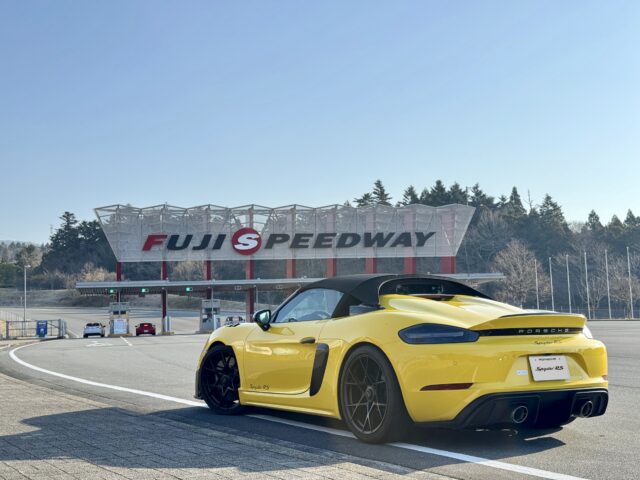
Heading to Fuji Speedway for the 911 Days Track Event
On March 22, 2026, I participated in a track event hosted by the magazine “911 Days.”
That day, around 58 Porsches gathered at Fuji Speedway. I join this event annually, and last year I drove there in a Taycan Turbo GT. This year, my partner on track was the 718 Spyder RS. Having a chance to unleash a convertible equipped with a GT3’s 4.0-liter flat-six at the main circuit is a rare privilege. Filled with both excitement and a bit of anxiety, I lined up on the pit lane.
My concern was about the soft top. The Spyder RS features a very simple folding roof, and the manual recommends avoiding speeds over 200 km/h. On Fuji’s straight, surpassing 200 km/h is effortless. Would it really be okay to push it that fast? I’ll discuss this in detail at the end of the article.
The Spyder RS Transforms on the Track — A “Limit Barometer” You Can Feel
After a few laps, my honest first impression was: “exceptionally easy to handle.”
To be frank, on mountain roads, the Spyder RS didn’t thrill me as much as the GT3. The RS’s suspension is completely different from the standard 718 Spyder without the RS badge, and it’s undoubtedly an excellent car. Yet, at mountain road speeds, my impression was simply that the GT3 was more exhilarating. But once on the circuit, everything changed. The Spyder RS felt more manageable and easier to drive than the GT3. This was my genuine feeling at Fuji Speedway.
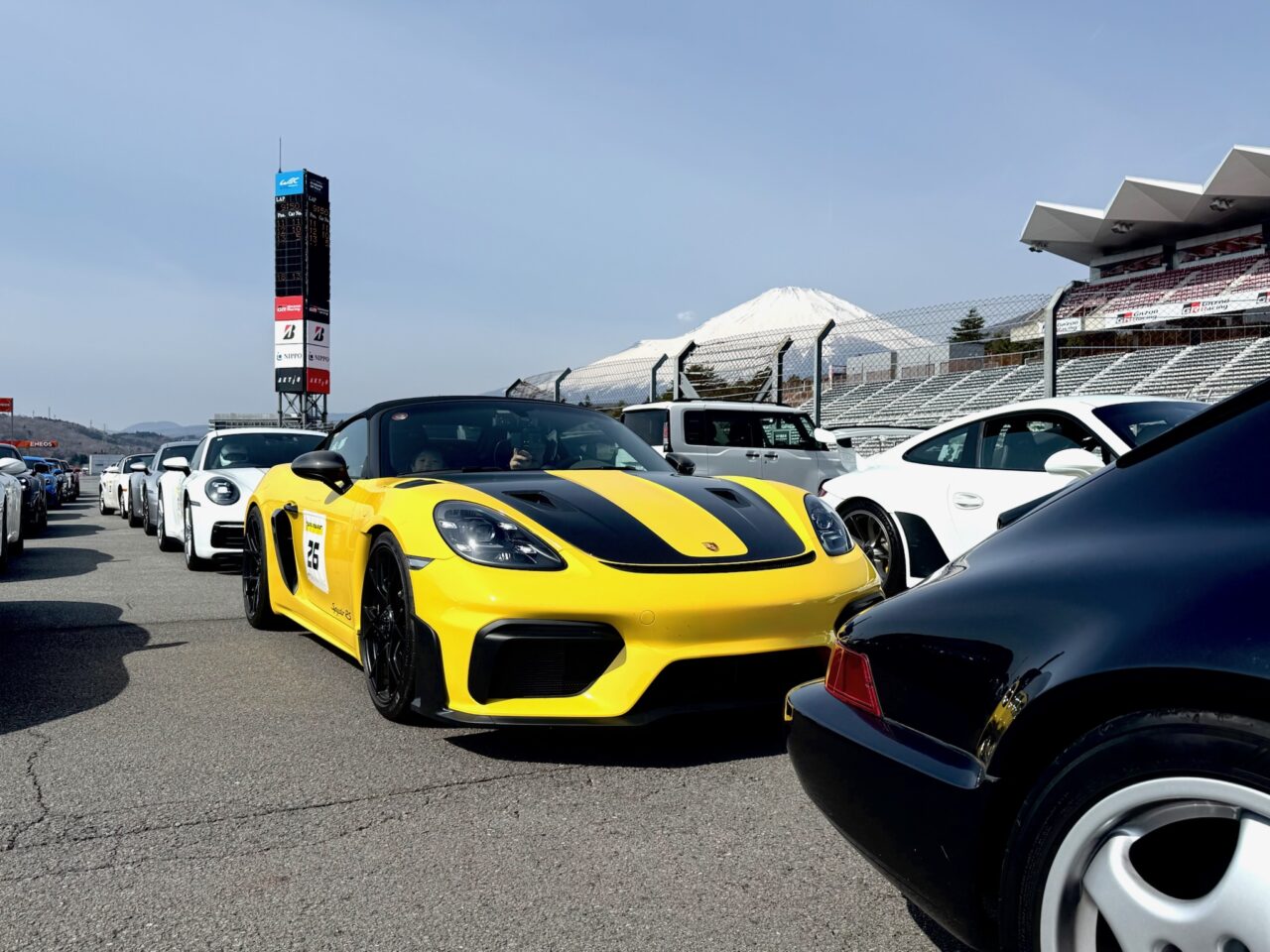
While its sibling GT4 RS is equipped with a stiff, track-focused suspension, Porsche themselves state the Spyder RS is tuned more for street use. I was curious—and a bit worried—how this slightly softer setup would feel on track.
For the first lap or two, the brakes weren’t yet at their peak bite, leaving me slightly unsatisfied. But as the pads heated up, the Porsche Ceramic Composite Brakes (PCCB) snapped sharply into action, instantly inspiring confidence in braking performance.
What impressed me most in cornering was how clearly I could sense the margin to the limit. There’s no gauge or meter displaying this, but it’s as if a “limit barometer” appeared in my mind: 50% now, 60%, then 80%. How far could I push before the tires would break loose? That boundary was communicated through the steering wheel and the chassis feedback. I felt safe to push—and safe to stop—at every turn. When I tackled Fuji two years ago in a 718 Cayman T, I already thought the car was easy to drive. The Spyder RS amplified that ease even further.
I consider the 992-generation Carrera an incredibly controllable car as well. However, it relies heavily on electronic aids, digitally smoothing out the rear-engine characteristics to the point where you almost forget it’s a rear-engine car. The Spyder RS’s controllability, by contrast, feels more analog. Electronic interventions are noticeably fewer compared to the 992, offering much more direct driver input. The raw feel of the road grip, chassis limits, and tire edges comes through with minimal filtering—an experience unique to this car.
Dunlop SPORT MAXX Race 2 Tires: Better Than Expected
Let’s talk tires.
The Spyder RS delivered to me came equipped with Dunlop’s SPORT MAXX Race 2 from new. Honestly, I had been a bit disappointed it wasn’t Michelin Cup 2 tires, thinking those might be better. However, this track day completely reversed my preconceptions. These tires are genuinely impressive.
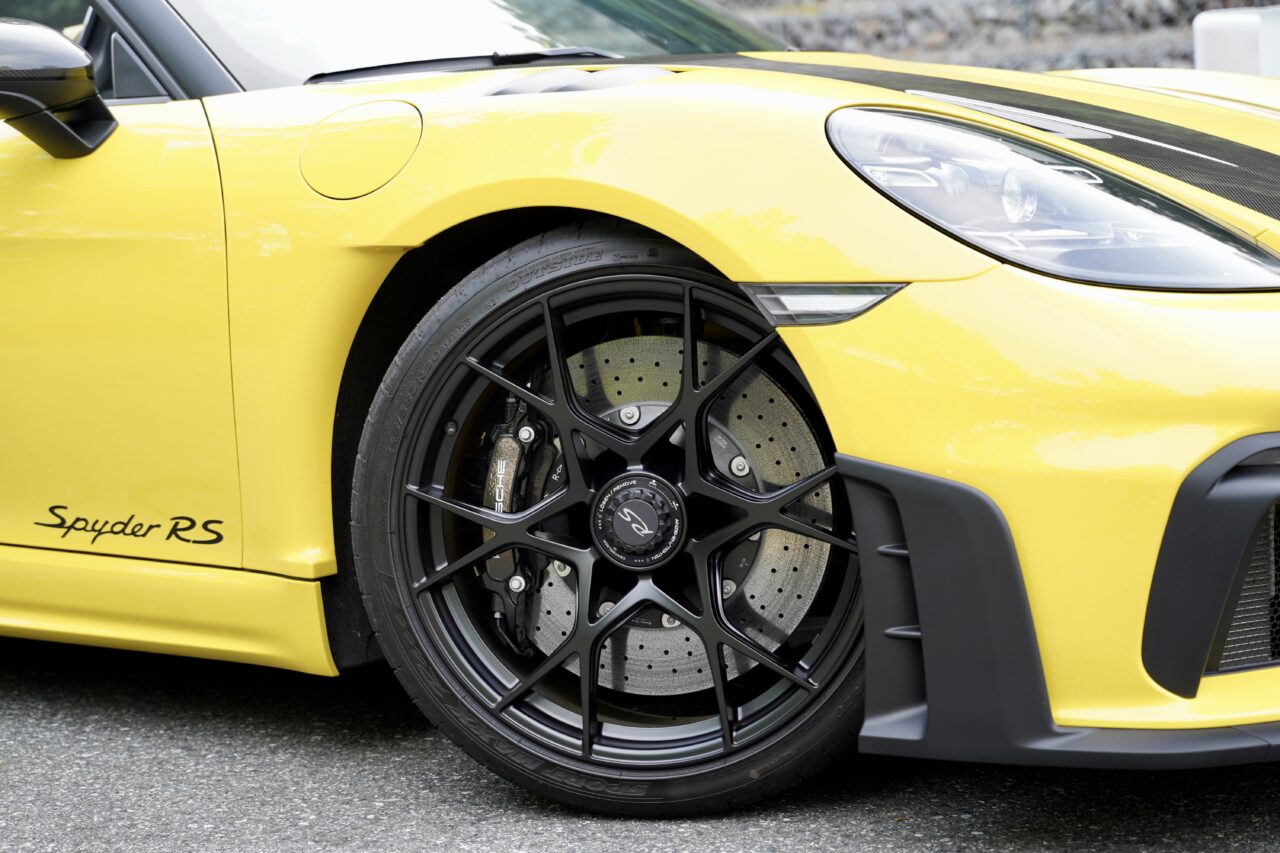
The grip exceeded my expectations, but what amazed me even more was their resistance to heat fade. Back when I drove a 991 GT3 Touring with Cup 2 tires, pushing hard for 30 minutes would visibly degrade grip. The tires would feel mushy in corners, and I accepted that as a Cup 2 characteristic. But the SPORT MAXX Race 2 held steady until the end of my session. Not perfect zero fade, but nearly consistent grip throughout.
They also perform well on public roads. In cold winter conditions, Cup 2s sometimes clattered noticeably through curves at about 40 km/h due to poor low-temperature grip. The Dunlops don’t display this behavior. While far from street tire levels of grip, they do offer usable traction in cooler temperatures. I feel these tires strike a great balance between track durability and everyday usability. When I next replace tires, I’ll choose the SPORT MAXX Race 2 without hesitation—and definitely won’t revert back to Cup 2.
PDK Blipping and the Roar of the GT3 Engine
Now, how could I not talk about the sound?
The Spyder RS’s PDK transmission delivers an incredible show, even in automatic mode. Accelerate on the straight, brake hard before a corner, and the gearbox downshifts rapidly from 5th to 4th, then 3rd. The fierce blipping and lightning-fast shifts perfectly embody the phrase “in the blink of an eye.” The sharp matching of revs bang-bang resonates behind me and physically vibrates through the chassis. Several times, I forgot the lap times and simply reveled in this auditory spectacle.
The high-rev howl of the GT3 engine as it climbs to 8,000 and 9,000 rpm remains unchanged. That soul-stirring, almost pleading scream is intact. In fact, the open-top body makes it feel even more immediate. Even with a helmet on, the 4.0-liter flat-six’s scream delivered goosebumps with its sheer intensity. Just this engine and PDK combination alone justifies the purchase.
Spyder RS was fantastic! A Porsche that’s incredibly easy to drive and truly connects driver and machine. Of all I’ve driven, it’s by far the easiest to handle on the circuit! Makes me want a GT4 RS. #SpyderRS #FujiSpeedway pic.twitter.com/eOUEQWnTQp
— Hiro @Welcome Home, PORSCHE (@boxster_gts) March 22, 2026
Is It Safe to Drive Over 200 km/h with the Soft Top Up?
Finally, I want to address what many readers are probably most curious about: the roof.
The Spyder RS’s top is extremely simple with almost no frame. The manual advises against speeds over 200 km/h, and indeed, exceeding that triggers a warning on the dashboard. Driving on Fuji’s straight naturally triggered this caution, but I reached a top speed of 271 km/h—and there were no issues.
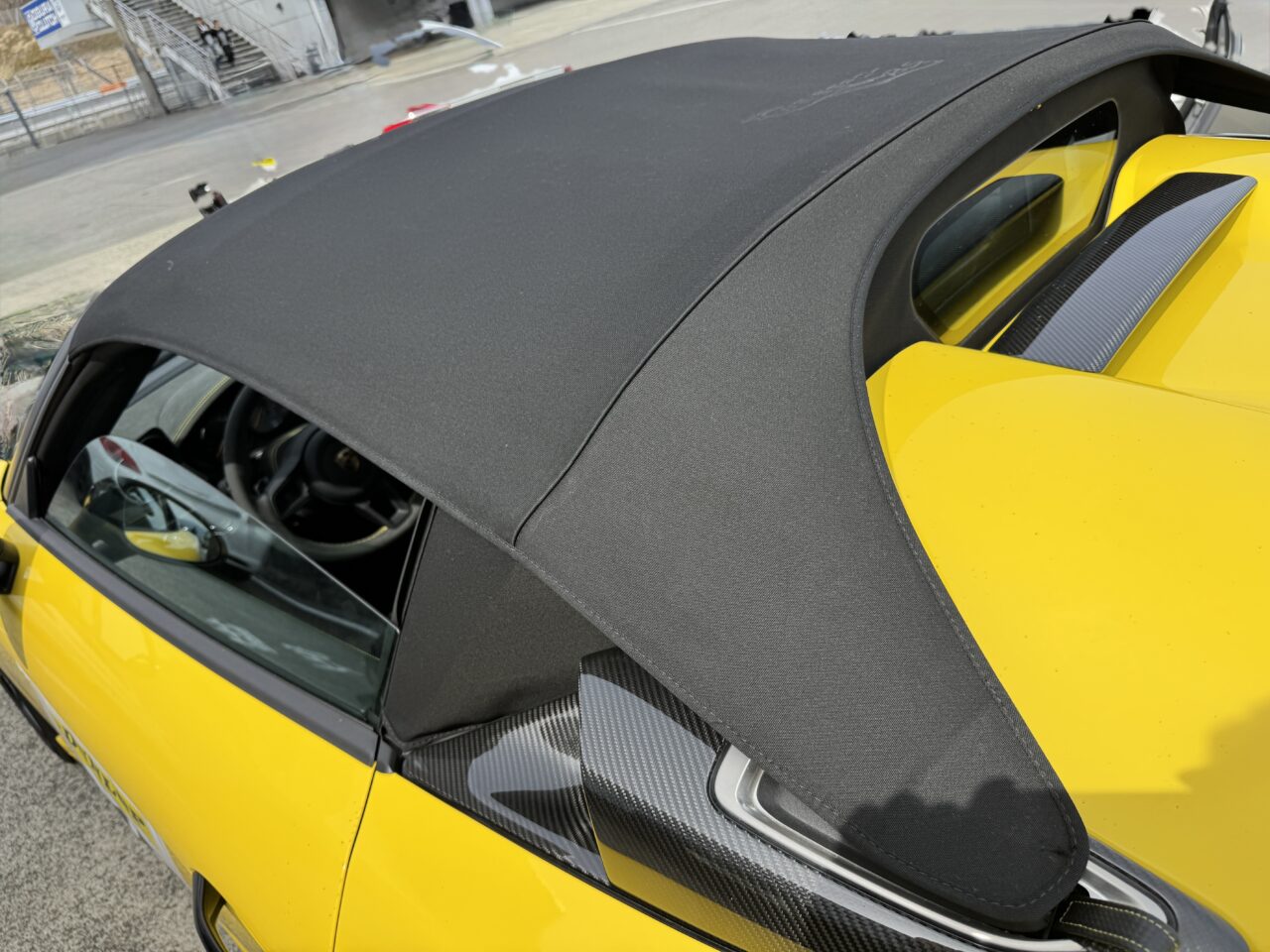
Inside the cabin, I felt no abnormalities—no flapping noises, no whistling air leaks, no rattles. The wind and road noise at those speeds were loud enough to mask any subtle sounds, but my senses told me the situation was calm. However, photos taken by my brother from outside clearly showed the soft top ballooning. At high speed, the airflow above the roof seems faster, creating suction that pulls the fabric upward like a balloon.
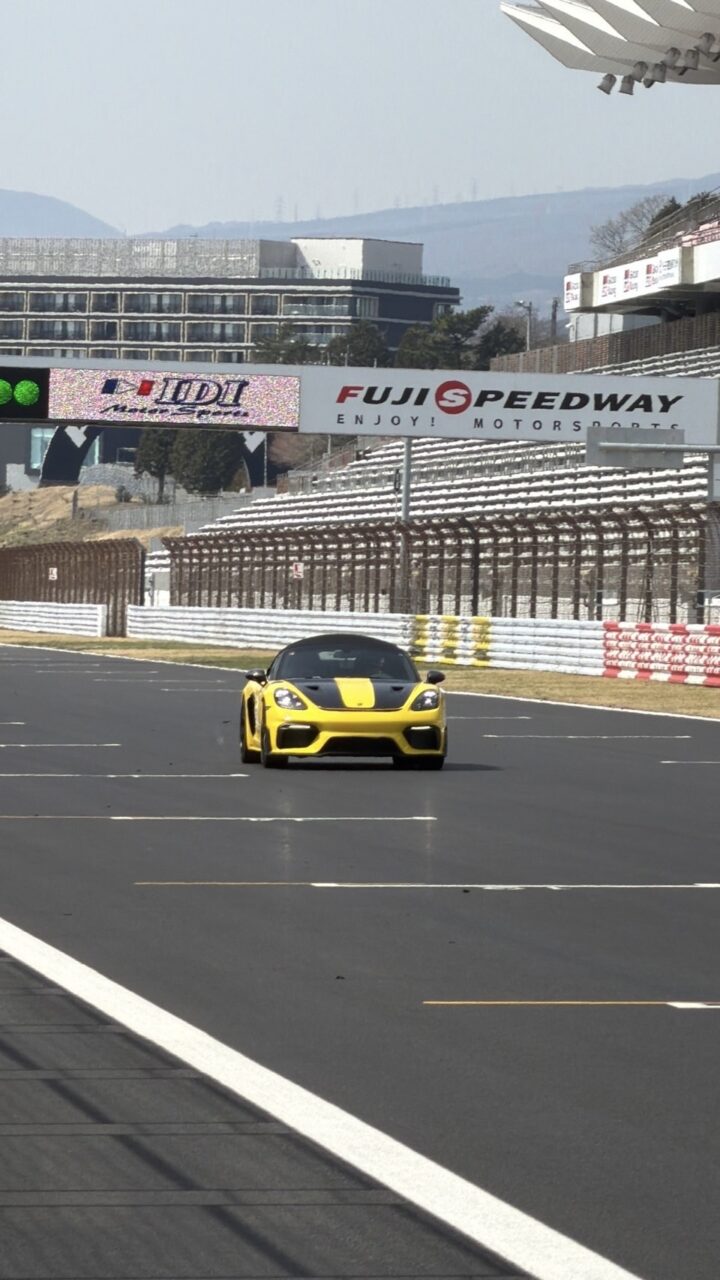
Interestingly, on the way home cruising at about 120 km/h on the new Tomei Expressway, I placed my hand on the roof and realized it was already significantly bulging. This is simply how the Spyder RS roof behaves. At the circuit, the sections above 200 km/h are very brief, so the roof likely doesn’t endure great stress. However, extended cruising above 200 km/h like on Germany’s Autobahn is probably unwise. Note that Fuji Speedway requires the roof to be up during the event. While Porsche advises removing the soft top above 200 km/h, the organizers mandated the roof remain installed for occupant safety. This point is important to mention.
Many considering Porsche ownership and wanting to take the Spyder RS to the track worry about this roof issue. I hope my experience offers some helpful insight. If the opportunity arises, I’d love to run Fuji again in this car.
このブログが気に入ったらフォローしてね!
Comment ( 0 )
Trackbacks are closed.
No comments yet.