

Feeling the Limits of CHAdeMO with the Taycan: Why Japan’s EV Charging Infrastructure Should Switch to NACS
公開日:

コンテンツ
The Taycan, Fuji Speedway, and the Charging Blues
Recently, my wife and I took her Taycan 4S Cross Turismo all the way out to the Fuji Speedway area.
The driving experience itself was flawless. The real challenge was the “charging” stops along the way. We tried using the e-Mobility Power CHAdeMO fast charger at a highway service area, and the complexity of this charging process is really tarnishing the perception of EVs themselves, I realized once again.
To be clear, it’s not that EV charging is inherently troublesome — it’s the CHAdeMO system that’s complicated.
CHAdeMO: More of a “Trial” Than a Convenience
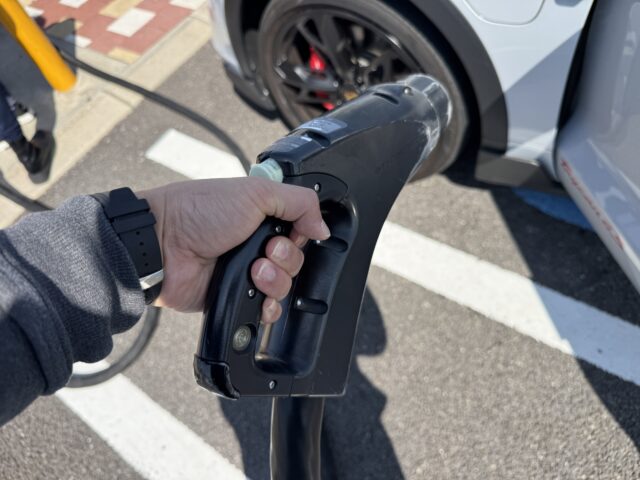
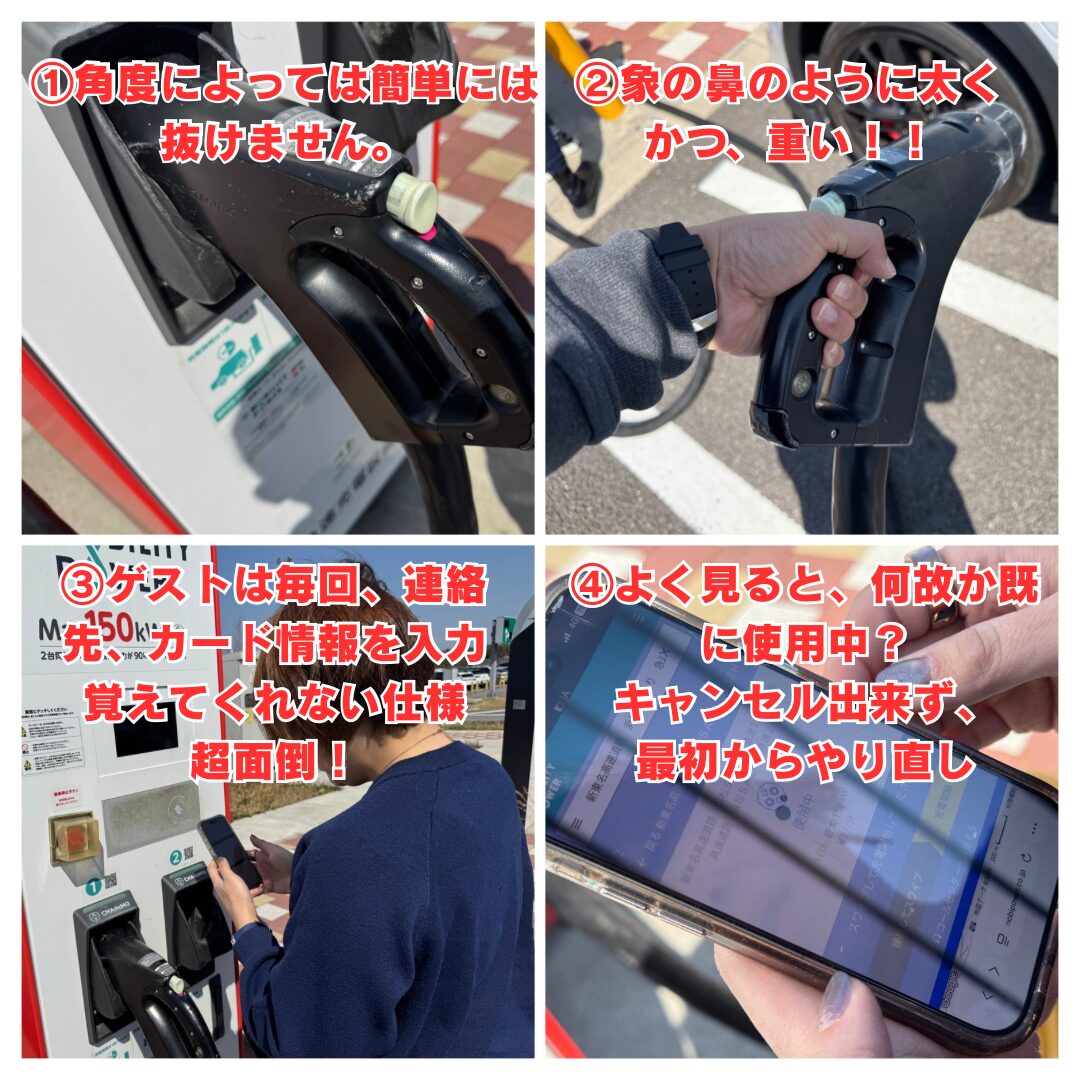
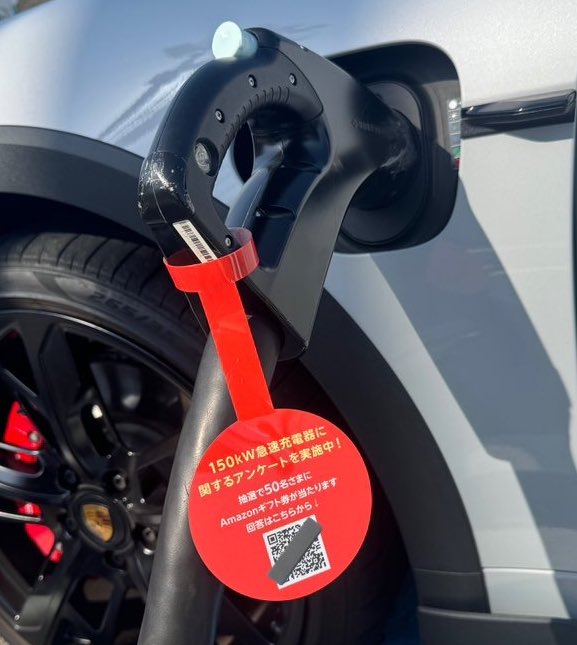
The CHAdeMO connector is downright heavy.
It’s so cumbersome that you really need both hands just to plug it into the port securely. I completely understand why my wife tends to avoid charging stops away from home. Beyond this physical hurdle lies another maze: the authentication process.
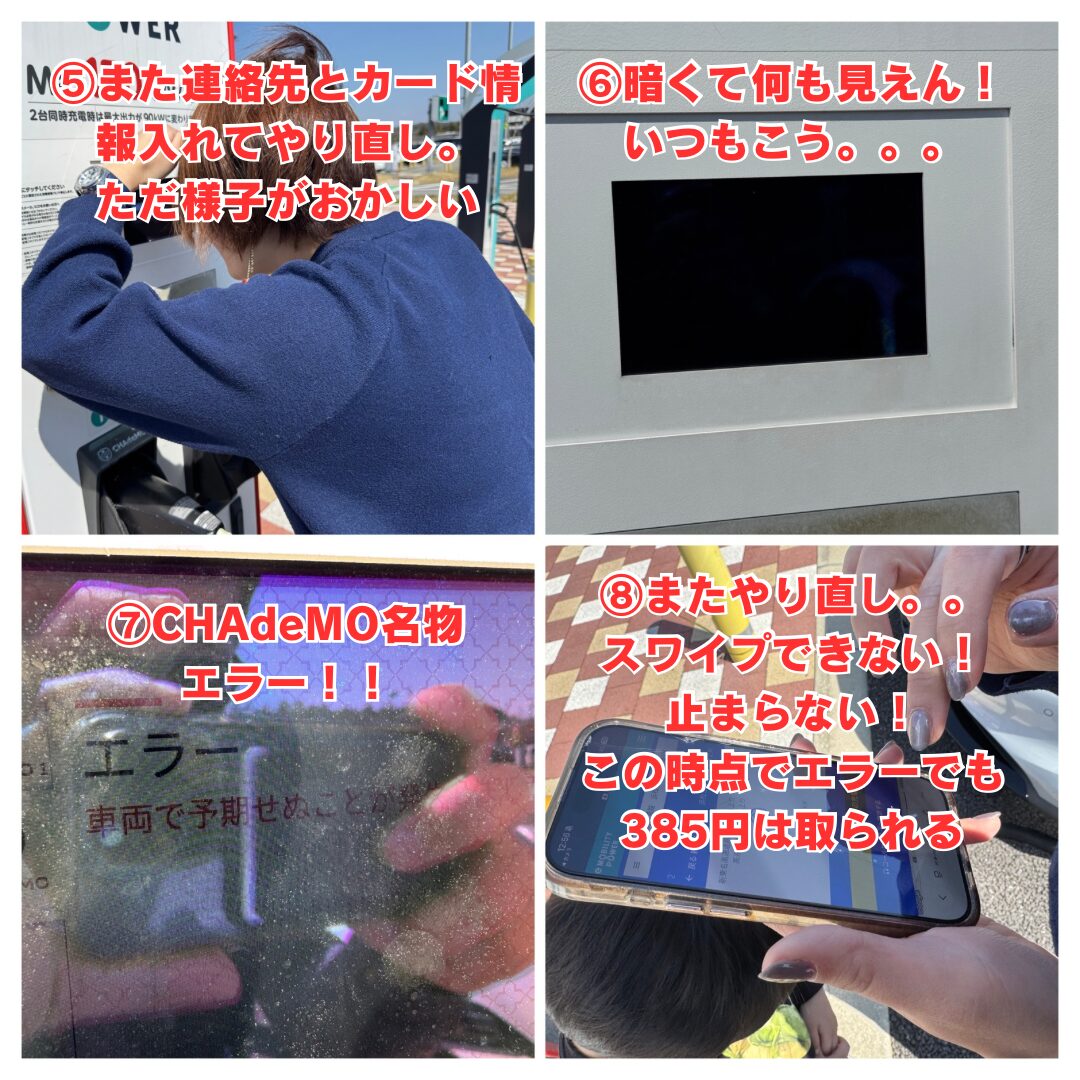
For chargers like those from e-Mobility Power, you must scan a QR code, access a website, and enter your name and credit card details. Since I mostly charge at home, I’m not a member, so every guest-use charge means repeating this entire sequence. Even if you recharge multiple times in one day, you have to input all info each time. None of the data is stored.
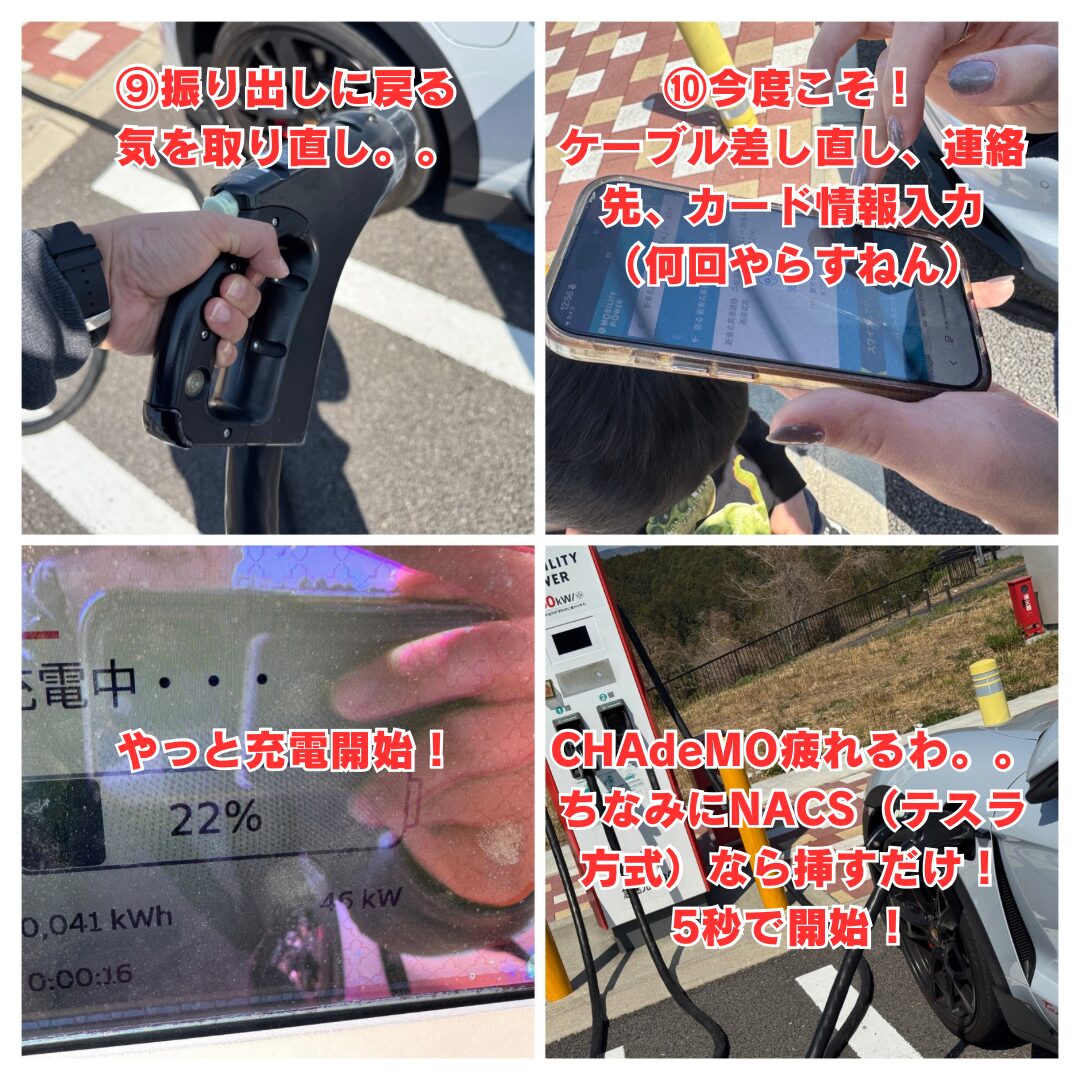
Adding insult to injury, CHAdeMO’s design prioritizes safety so heavily that many errors occur during pre-communication between car and charger, often leading to unfair charges. Just when you think charging has finally started, an error stops the session. What’s worse, even if no power flows, you still get charged an initial fee of a few hundred yen.
This is an outdated system that puts operators’ convenience and complaint prevention far above user-friendly design.
Once You Know NACS, There’s No Going Back
We also own a Tesla Model 3, so I experience daily the stark difference between NACS and CHAdeMO standards.
Charging with NACS is astonishingly simple.
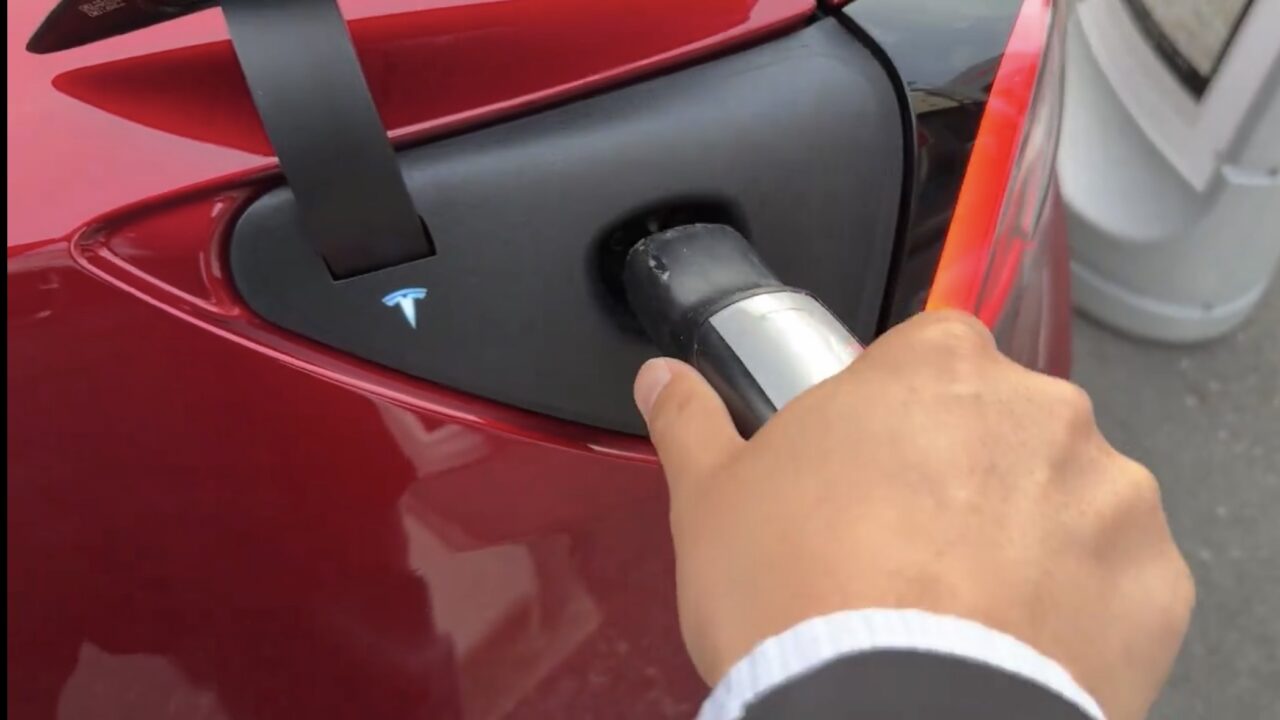
NACS: Just plug it in—no need to start charging, no credit card info or personal data input—done in 5 seconds.
The connector is compact and can be handled effortlessly with one hand. You just plug the cable into the port, and authentication and payment happen in the background within seconds, starting the charge immediately. No QR codes, no personal data, no app fiddling.
In North America, Porsche has already begun offering NACS adapters, and 2026 Taycan and Macan Electric models come standard with them. With global giants like GM, Ford, Hyundai, Nissan, and Stellantis brands adopting NACS, the world trend is clearly moving toward NACS.
Signs of change are emerging in Japan as well. The Sony-Honda joint venture AFEELA will be the first domestic NACS adopter, and Mazda plans to offer NACS in Japan starting 2027. ABB will begin shipping dual CHAdeMO/NACS chargers to Japan in 2026. While CHAdeMO, a Japan-originated standard, remains ahead in V2H (Vehicle-to-Home) tech, it’s undeniable that internationally, it’s losing ground as a mainstream standard.
Where PCA Stands Now—and Hopes for Porsche Japan
I firmly believe now is a pivotal moment.
Porsche Japan’s Premium Charging Alliance (PCA) boasts a network of around 370 locations with over 385 fast chargers nationwide. By 2025, mutual use with Lexus chargers will also begin, showing steady growth in premium EV infrastructure.
That said, all PCA chargers currently use the CHAdeMO standard with a maximum output of 150kW. If PCA is to expand further, it makes perfect sense to consider adopting the NACS standard for new installations.
Porsche owners come from diverse age groups, and many may not be comfortable with complex smartphone operations.
The simple experience of “just plugging in and instantly starting to charge” perfectly suits the Porsche brand’s premium image.
I have previously responded in detail, with great enthusiasm, to a PCA survey from Porsche Japan—urging early NACS adoption in Japan and the provision of adapters for existing owners. I imagine many Porsche owners reading this share the same hope.
Regarding Porsche’s rapid charging infrastructure, I sincerely request a shift from CHAdeMO to the NACS standard (SAE J3400) moving forward, and the early availability of a Japan-specific NACS DC adapter for existing users (allowing Taycans and others to use NACS chargers).
I currently own both a Tesla and a Taycan, regularly using both NACS and CHAdeMO chargers. From my experience, NACS is clearly superior in convenience, usability, and reliability, with negligible charging errors. On the other hand, CHAdeMO involves complex authentication and safety confirmations on both car and charger sides, sensitive to manufacturer and charger model differences, leading to frequent “failed charging start” and reattempts in real use.
NACS employs a single, compact connector for both AC and DC charging, and enables authentication and payment simply by “plugging in.” Globally, many manufacturers centered in North America—GM, Ford, Hyundai/Kia, Nissan, and Stellantis brands—have declared intentions to adopt NACS, positioning it as a leading candidate for a future global standard.
While CHAdeMO is a respected Japan-originated standard with excellent safety and protection features, its large connector size and complicated processes involving app usage, membership authentication, and multiple button presses inevitably add complexity. Globally, the trend toward CCS and NACS adoption is accelerating, with CHAdeMO’s market share steadily declining in some regions.
Porsche Japan has already built one of Japan’s largest premium charging networks—with Porsche Turbo Charging Stations, Destination Charging, and Premium Charging Alliance (PCA), comprising 375 locations and 390 rapid chargers nationwide as of May 2025.
I believe the network is still fluid enough to realign with future standards, making this an ideal time for Porsche Japan to take a leadership role in transitioning to NACS.
Also, Porsche’s owner base spans wide age groups, including many less comfortable with complex smartphone apps or infotainment systems. For these customers, a straightforward, reliable experience of “just plugging in and charging immediately” is a premium user experience befitting the Porsche brand.
For these reasons, I earnestly urge that future rapid charging installations and upgrades consider adopting the NACS standard. Moreover, providing a Japan-market NACS adapter as soon as possible, like in North America, to existing Taycan owners and others would be greatly appreciated.
I look forward to Porsche’s e-mobility strategy and premium charging experience continuing to lead the global EV market.
I wrote this article hoping to help push Japan’s EV charging infrastructure in a better direction.
I sincerely hope Porsche Japan takes notice.

このブログが気に入ったらフォローしてね!
Comment ( 0 )
Trackbacks are closed.
No comments yet.