

911 GT3 Artisan Edition Debuts — Specs of Japan-Only 30 Units and the Legacy of “Japan-Exclusive Porsches” Since Mitsuwa
公開日:

コンテンツ
What Is the 911 GT3 Artisan Edition?
On April 27, 2026, Porsche Japan officially unveiled the “911 GT3 Artisan Edition.”
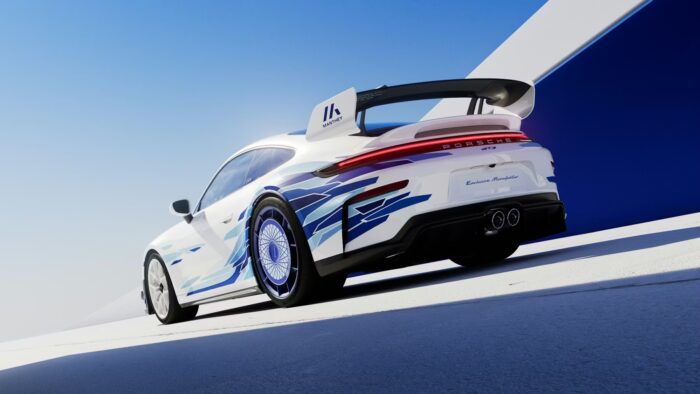
Limited to 30 units exclusively for the Japanese market, this marks the first Japan-only model crafted by Porsche Exclusive Manufaktur specifically for Japan. The number 30 pays homage to Porsche Japan’s 30th anniversary on November 17, 2025. With the theme “True luxury lies in the details,” this car fuses the spirit of Japan’s most revered traditional crafts—Edo Kiriko glass cutting and indigo dyeing—with the pure engineering ethos of the 911 GT3.
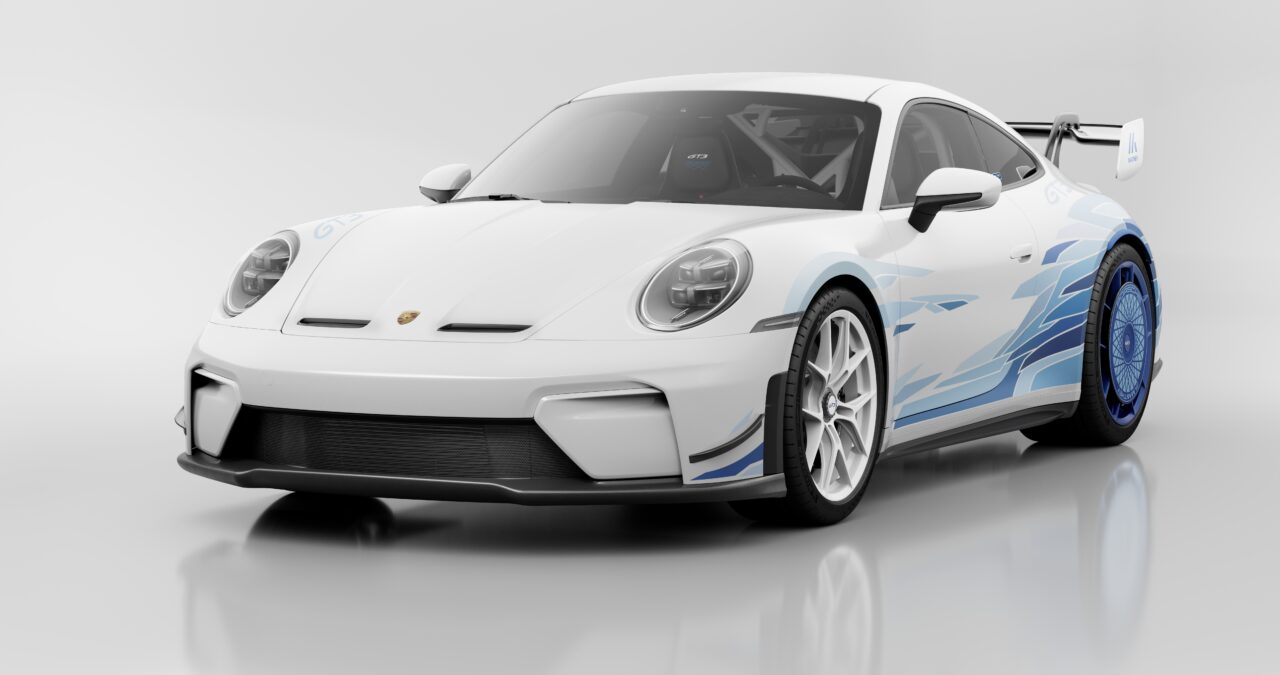
It’s rare to see a Porsche so clearly marked “made for Japan.”
While import commemorative models pop up worldwide, cases where Porsche Exclusive Manufaktur has earnestly developed a model solely for Japan are exceedingly rare. Just recently, the Manthey Kit, priced at 9.4 million yen, became available in Japan. Few expected a special edition with this kit as standard to follow. This is not simply a commemorative model, but rather, a gesture of gratitude from Porsche Japan to the market it has cultivated over 30 years.
Specs and Equipment of the Artisan Edition
Let’s break down the base: the 911 GT3 (992.2 generation).
It features a 4.0-liter naturally aspirated flat-six engine with 510 PS peak power, 450 Nm torque, and a redline of 9,000 rpm. Importantly, these specs remain unchanged in the Artisan Edition. The difference lies not in the mechanics but in the aesthetic layering applied.
Key specs and equipment include:
【Main Specifications】
・Engine: 4.0L naturally aspirated flat-six
・Max power: 510 PS
・Max torque: 450 Nm
・Redline: 9,000 rpm
・Transmission: Manual / PDK (as on standard GT3)
・0-100 km/h: 3.4 seconds (PDK, approximate)
・Wheels: Front 20-inch White paint / Rear 21-inch Club Blue with carbon aero discs
【Standard Manthey Kit Components】
・Aluminum shock bodies
・Four-way adjustable coilover suspension with top mounts
・Brake lines with steel sleeves
・Optimized underbody
・Front lip and flaps
・Carbon aero discs
・Rear diffuser
・Reinforced carbon rear wing with large endplates
The most significant distinction from the regular GT3 is that the Manthey Kit is standard. This kit alone costs 9.4 million yen as an option. Thus, the Artisan Edition clearly positions itself not as a mere special paint GT3 but as a Japan-exclusive circuit-spec Porsche. The domestic price was undisclosed at the April 27 announcement but, considering the 30-unit production, most allocations are likely already reserved.
Edo Kiriko and Indigo Dyeing — The Art in the Details
The essence of this car is in its details.
The body is primarily white, layered with Porsche’s Paint to Sample (PTS) Club Blue (W60), accented in soft blue tones. The side graphics depict a gradient representing “the flow of air and time,” paying homage to the Japan Blue symbolized by indigo dyeing. The carbon aero discs at the rear feature bespoke modern interpretations of Edo Kiriko traditional patterns “Nanako” and “Yarai.” From afar, they resemble classic BBS mesh wheels, but up close, the intricate Kiriko geometric patterns emerge.
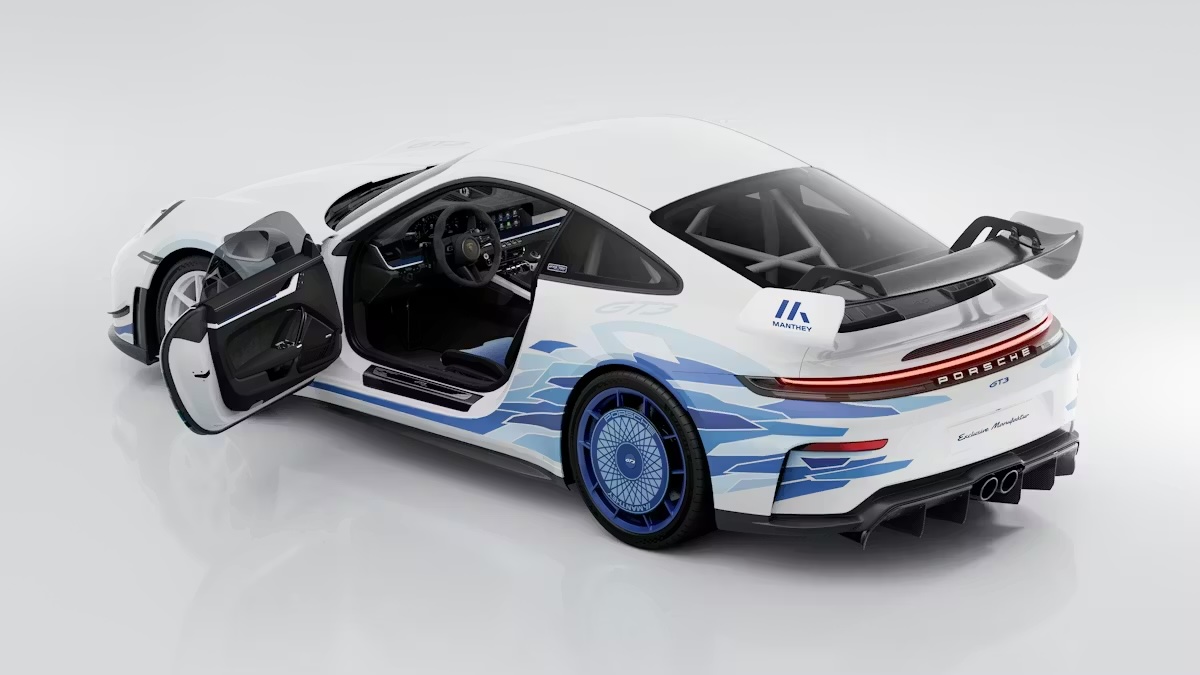
A highlight is the hand-painted lettering on the underside of the rear wing: “Engineered in Flacht, Sharpened in Meuspath, Built for Japan.” Flacht is the Porsche GT division headquarters; Meuspath is where Manthey is based. Each unit receives this inscription by hand from Exclusive Manufaktur craftsmen. We rarely see vehicles upside down, but this personal touch stating dedication to Japan speaks volumes about the seriousness of this project.
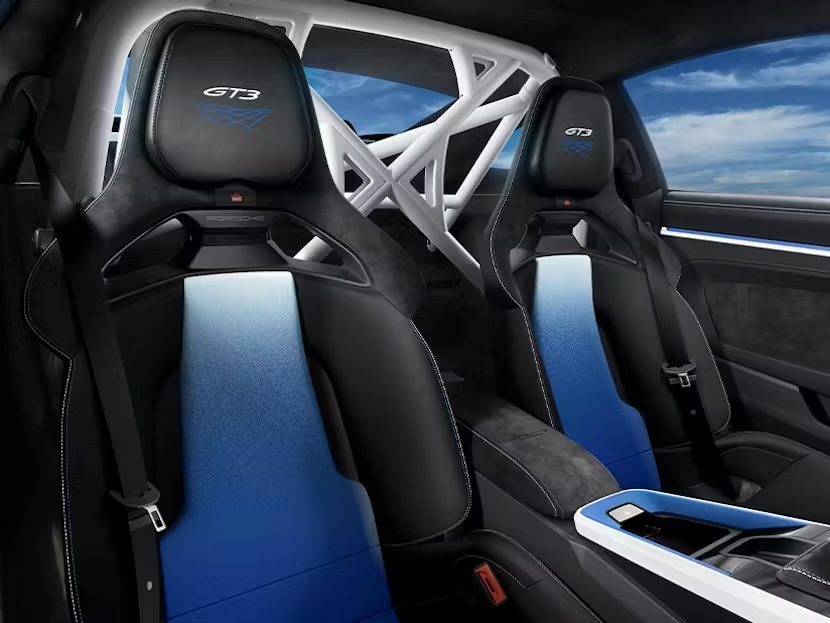
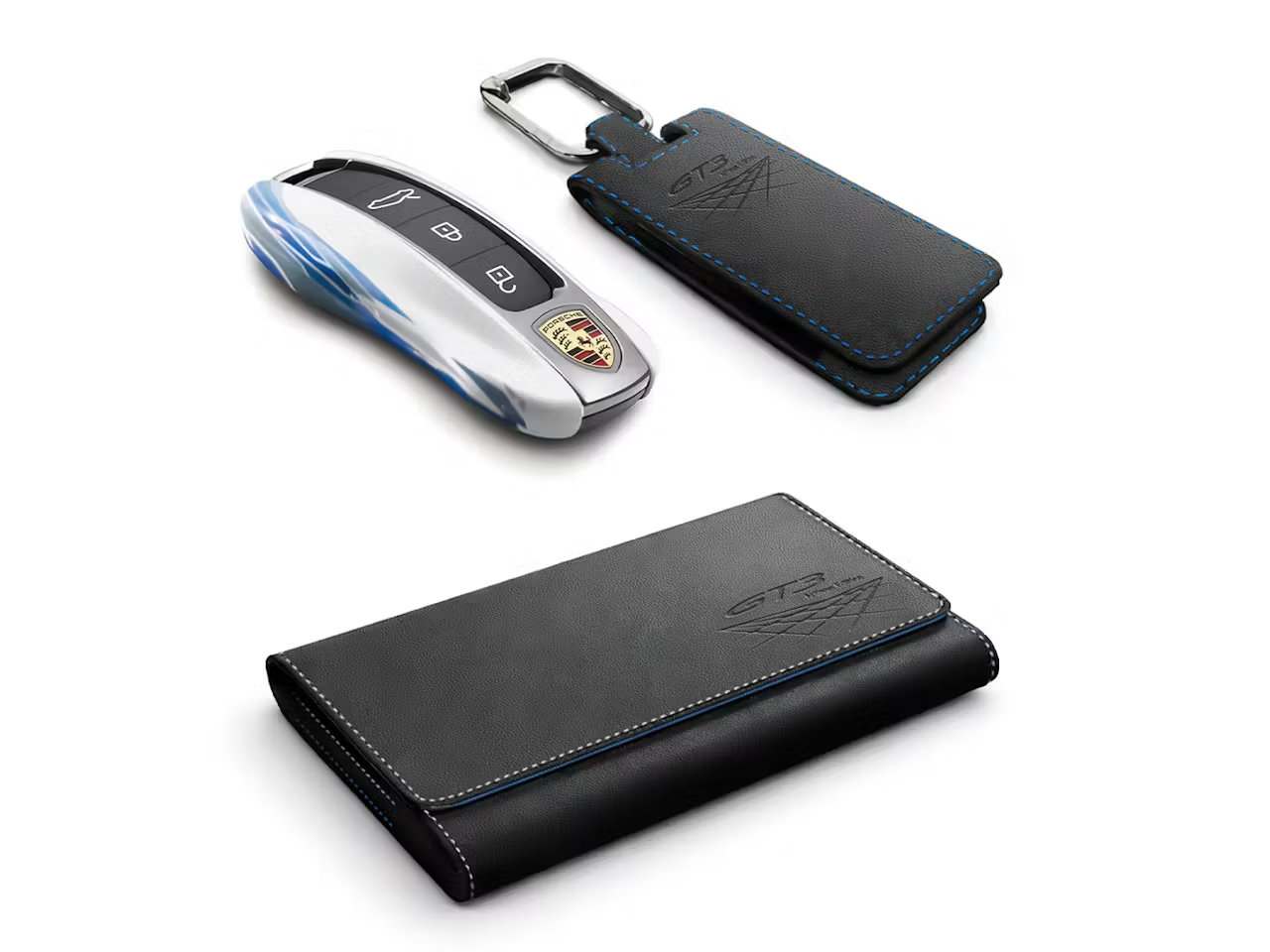
Inside, the black interior is accented with Speed Blue and white double stitching. The roll cage is painted white; the seat centers feature a deep gradient inspired by indigo dyeing; the headrests bear Kiriko-inspired blue embroidery reading “GT3.” Even the key shares the body’s white paint and features a graphic overlay. Having owned a current GT3 Touring myself, I appreciated its unique charm, but the Artisan Edition’s craftsmanship is in a league of its own. The cumulative handwork creates a value that transcends mere performance numbers.
The Legacy of Japan-Exclusive Porsches from the Mitsuwa Era
Let’s take a moment to look back at past Japan-exclusive Porsches.
The history of Porsche in Japan predates the direct establishment of Porsche Japan. Mitsuwa Motor Sales (later Mitsuwa Motors / MIZWA) imported two Porsche 356s in 1953, marking the true beginning of Porsche’s presence here. Until the business transferred to Porsche Japan in November 1997, Mitsuwa supported Japan’s Porsche scene for nearly half a century. Mitsuwa indisputably laid the foundation of Japan’s Porsche culture. My own 964 Carrera 2 is a Mitsuwa officially imported example; seeing the MIZWA logo on early maintenance records adds unique historical perspective.
Japan-specific Porsches commissioned during the Mitsuwa era remain rare, concentrated mainly in the air-cooled generation. Several variants of the 993 are well-known examples.
【Notable Japan-Only Porsches】
・911 Carrera (993) Aero Version: Limited to 30 units. A special edition of the last air-cooled generation featuring a Turbo-look large rear wing, front lip, and side skirts. Iconic of the MIZWA era rare Japan exclusives.
・911 Carrera S (993) Aero Version: Around 85 units. A wide-body, air-cooled finale model with aero components that commands special status in today’s used market.
・911 Carrera 4 (993) Narrow-Body Japan Spec: Narrow-bodied with a 3.8L M64/05S engine tailored for Japan, estimated production around 75 units, very rare.
・964 Turbo 3.3 Limited: Rare Mitsuwa-imported model with exclusive engine and interior specifications confirmed.
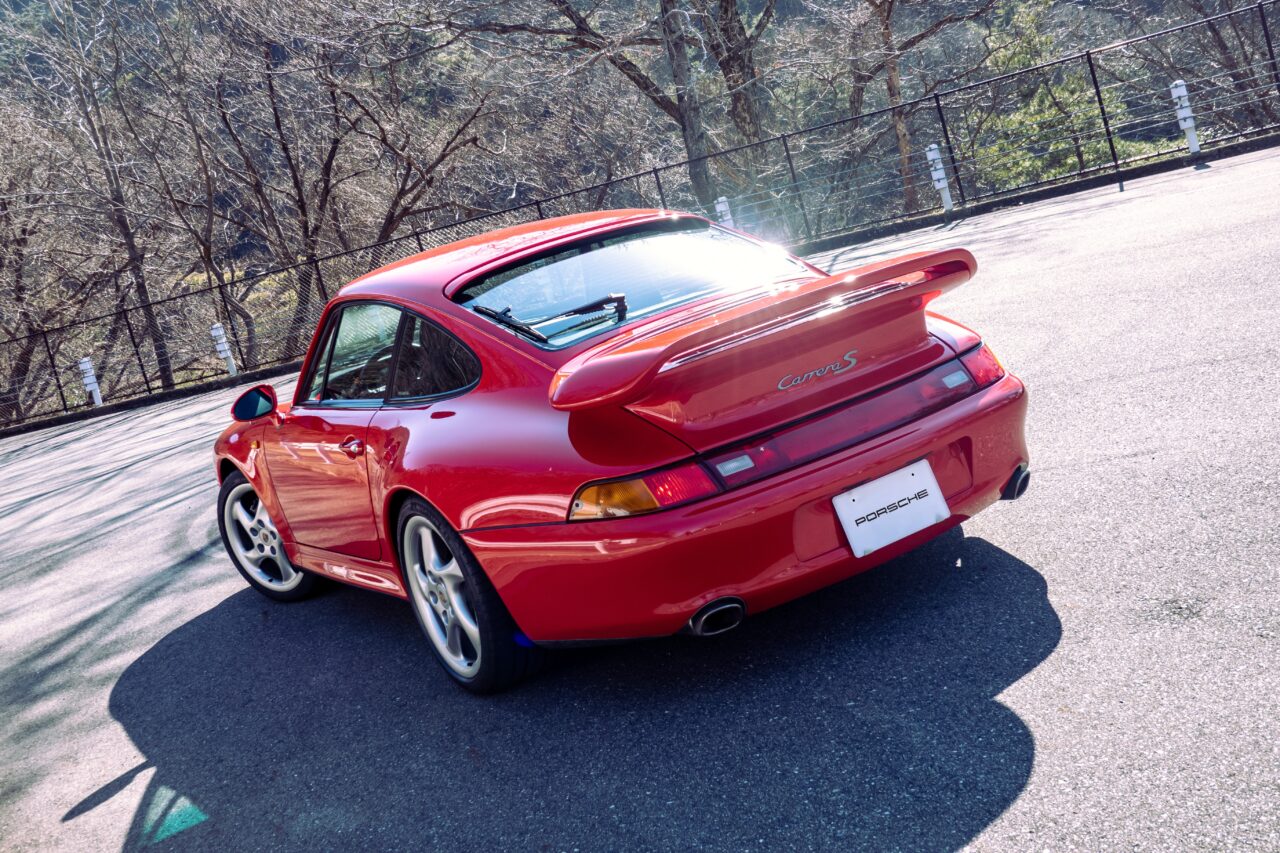
993 Carrera S Aero Version
Looking at these numbers—30, 85, 75—it’s clear that Mitsuwa’s air-cooled Japan exclusives were highly limited relative to the market size. Still, these cars became legendary among owners: “one of those 30 units.” Now, with the Artisan Edition also limited to 30 units, the tradition returns. Standard Manthey Kit, custom PTS paint mixing, Edo Kiriko wheel patterns, indigo-dyed seats, and hand-painted lettering demonstrate Porsche Japan and Exclusive Manufaktur’s dedication to crafting a true “made-for-Japan” machine. The overlap of the 30-unit mark on Porsche Japan’s 30th anniversary feels almost fated.
Is This an Investment Piece? — If You Can Accept That, It Might Be Worth It
Having reviewed the specs, here’s my candid take.
This car appears to me as an “investment piece.” Something held with the expectation of appreciation, not as a regular-driving tool. With only 30 units made, standard Manthey Kit, Exclusive Manufaktur craftsmanship, and allocations likely prioritized for Porsche’s royal customers, it’s hard to see this hitting the open market. In an era where the 911 Sport Classic sells for twice its original price, it’s unlikely these will be daily drivers.
It’s hard to imagine anyone driving this car regularly. Using a Manthey Kit-equipped GT3 for daily commuting or casual drives isn’t practical. Owners would blanch if their hand-painted lettering on the rear wing suffered rain damage or the white rear discs scraped a curb. Much like no one hammers Edo Kiriko glass, this Porsche isn’t made to be driven hard but to be owned and watched as an appreciating asset.
That said, embracing this mindset clears the air.
Rather than marketing it as a “special edition usable every day,” Porsche Japan openly declares it as an investment. Edo Kiriko and indigo dyeing are traditionally classified as art. Mounting them on a 911 GT3 base already signals this is intended as an asset. These 30 cars should belong to owners who have no intention to drive them hard. Personally, I’m not interested in Porsches that just sit, but the fact there are 30 such owners in Japan shows Porsche Japan has succeeded in creating this concept. This, too, is a testament to the 30-year evolution of the Japanese market.
このブログが気に入ったらフォローしてね!
Comment ( 0 )
Trackbacks are closed.
No comments yet.