

【Live Stream Summary】Vol.109: Thrilling Drive at Fuji with the 718 Spider RS & Family Interest in Tesla Model YL!
公開日:2026.04.09
Live Streaming

This is a summary article of the recent live stream radio show “Welcome Home, Porsche.”
Feel free to listen during your commute, school trip, or while enjoying a drive in your Porsche.
If you like the content, please give us a thumbs up and subscribe to the channel!
コンテンツ
Main Topics and Highlights
First Live Stream in Weeks & Sundabburukurinku Drive [0:15]
- After about 3-4 weeks, the live stream returned. On that day, we drove the Turbo GT through Sundabburukurinku, a popular driving route in Sanda City, Hyogo Prefecture. The cherry blossoms were stunning, but there were very few safe spots to stop and take photos.
- Since introducing Sundabburukurinku on the blog, many readers and Threads followers have reported driving the route. Given the limited driving spots in Kansai, the Sanda area remains a precious local gem for Porsche owners.
- Although not finalized yet, we plan to attend the Porsche Carrera Cup Japan (PCCJ) at Suzuka again this September.
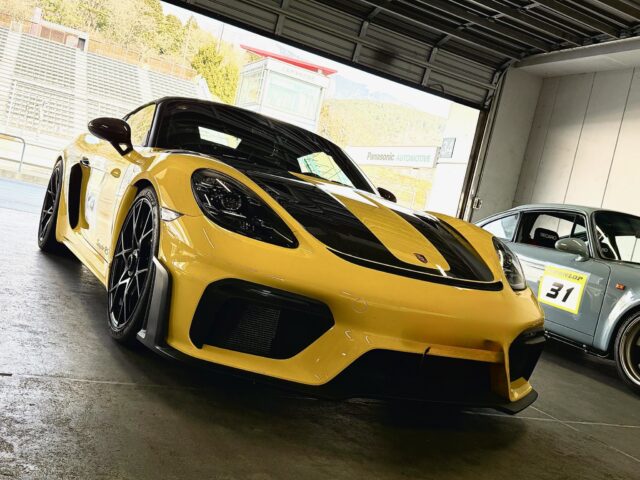
Driving the 718 Spider RS at Fuji Speedway [6:55]
- We joined a send-off event at Fuji Speedway with the 718 Spider RS. As detailed in the blog, this car performs impressively on track and cruising with the soft top closed over 200 km/h posed no issues.
- The highlight was the GT3 engine’s incredible soundtrack. The shift-down sounds in PDK’s automatic mode, especially when braking from 4th or 5th gear, were jaw-droppingly intense—even through the helmet. It was “a level of sound that could fuel three bowls of rice” just from the noise alone.
- Mina, however, found the Spider RS’s exhaust note a bit overwhelming—a powerful pressure that can be tiring. By contrast, the 981 Boxster’s sound is refreshing. But on the circuit, that dynamic contrast might feel different.
- At high speed, the soft top bulges noticeably—so much so a hand could fit between the carbon panel and the fabric. It swelled even at 120 km/h. Since the Spider RS was originally designed to deliver top speeds without the soft top, it’s meant to be driven topless for optimal performance.
- At the event with 58 participants, astonishingly, the Spider RS secured first place. This sports car delivers lightning-fast lap times even for amateur drivers and can comfortably chase GT3 RS levels of performance.
Precise Handling and Cornering of the Spider RS [16:49]
- At Fuji’s first corner, entering at 65–70 km/h, the Spider RS’s steering response was razor-sharp. The car followed steering inputs exactly with no understeer or drifting. The Turbo GT, heavier by comparison, tends to drift out slightly in this section.
- In the 100R corner, it remained stable and confident above 130 km/h. The 981 Boxster starts to show noticeable body roll around 120 km/h, but the Spider RS felt like it had more grip and composure to spare.
- During the chicane at the Dunlop corner, quick steering inputs combined with lifting off the throttle made the car precisely change direction. Overall, the drive felt nimble and effortless, more relaxing even than the Turbo GT.
Desire for a GT4 RS and Thoughts on Dunlop Tires [22:29]
- After driving the Spider RS at Fuji, the urge to own a GT4 RS as a dedicated track car grew stronger. Without the soft top restrictions and with the rear wing, the GT4 RS should deliver even more stability. We think the base model with bucket seats is sufficient—PCCB brakes or the Weissach package aren’t essential.
- Despite the GT3 engine, the 718 generation feels more analogue and companionable compared to the ultra-refined 992. It’s an extension of the 981’s lineage, with a warm, human touch that owners cherish.
- The Dunlop Sport Maxx Race 2 tires equipped left a great impression: less heat deterioration than Michelin Cup 2 tires, maintaining strong grip even after 30 minutes. This means there’s still room to push the limits on track.
Long-Distance Travel with the Taycan — No Charging Time Lost [31:48]
- Our Fuji trip involved two cars: the Taycan Cross Turismo 4S and Spider RS. The Spider RS’s small fuel tank and poor fuel economy limited its range to roughly 500 km per full tank, requiring refueling stops.
- The Taycan dropped to 22% battery near Hamamatsu but recharged back to the 70% range while we enjoyed lunch. Overnight charging at the hotel on a 200V standard outlet easily brought the battery above 80% by morning. This meant no extra dedicated charging time was needed.
- Charging costs were minimal — about 1,100 yen per overnight charge. Compared to petrol costs, the savings and time efficiency are huge. Even the early-model Taycan can comfortably reach areas like Numazu from Kansai.
Japan’s Highway Charging Infrastructure Needs Improvement [36:18]
- While the Taycan’s charging capability is solid, Japan’s highway CHAdeMO stations are frustrating. Users must scan QR codes and input multiple forms of personal info every time, with frequent errors requiring restarting the process.
- The screens are often sun-damaged to the point of being unreadable. Some errors also incur initial fees. The charging cables are bulky and extremely heavy—too cumbersome for elderly users to handle, requiring a firefighter-like embrace to connect.
- In contrast, Tesla Superchargers require only a simple button press to connect, with lightweight cables and no credit card input. This difference likely reflects whether the designers actually drive EVs themselves.
Tesla Model YL Released! Brother Orders Immediately [41:19]
- The Tesla Model YL (6-seater) has launched, with a curb weight around 2 tons and a 0-100 km/h time near 5 seconds—very quick for its class. Hiro’s brother placed an order within 30 minutes of the April 3 launch announcement—one of the fastest in Japan.
- The brother recently grew fond of Porsche too, often visiting Rokko in a GT3 Touring. After experiencing Tesla in Hawaii and planning to buy a Model Y, he held out for the Model YL rumors and was pleased with the final specs.
- Subsidies include discounts and 3 years of free rapid charging. The Model YL is well equipped for families with standard features like ventilation, seat heaters, power recline, and electric folding seats.
Considering Switching from Taycan to Model YL [44:41]
- Hiro often parks in Osaka coin parking, where the Model 3’s narrower width (1,850 mm) makes maneuvering easier; thus, he plans to keep his Model 3. However, Mina started suggesting switching from the Taycan to Model YL.
- With three kids frequently bickering over the cramped rear seats of the Model 3 and Taycan, the Model YL offers a more peaceful solution: two seats in the second row and one in the third, reducing squabbles.
- Trade-in value for the Taycan appears low. The Model YL’s downside is its 6.3 m turning radius, limiting tight maneuverability. A detailed review will come once the brother’s Model YL arrives.
How Full Self-Driving (FSD) Will Transform Touring [53:47]
- Once FSD is released, Hiro expects to travel to Tokyo on business in the Model 3 instead of taking the Shinkansen. Considering the hassle of getting to Shin-Osaka, the convenience of relaxing during the drive while FSD handles the road will be preferable.
- Touring style will also evolve. Drivers can shift focus from road handling to sightseeing and enjoying surroundings. Experiencing FSD in the U.S., Hiro enjoyed casually taking in the scenery without concentrating on driving.
- Mina already works on her laptop in the Taycan’s passenger seat during trips, so FSD and Tesla’s Camp Mode—with uninterrupted air conditioning—will make in-car work and relaxation even more comfortable.
このブログが気に入ったらフォローしてね!
コメントを閉じる
Comment ( 0 )
Trackbacks are closed.
No comments yet.