

【Livestream Recap】Vol. 109: Blown Away by the 718 Spyder RS at Fuji—and Why the Family Is Eyeing the Tesla Model YL!
公開日:2026.04.09
Live Streaming

This is a recap of a recent livestream from *Welcome Home, PORSCHE*.
Whether you’re commuting, heading to school, or out for a drive in your Porsche, we hope you’ll enjoy listening along.
If you enjoy the episode, please give it a like and subscribe to the channel!
コンテンツ
Topics and Highlights
Back on the Livestream—and a Drive on the Sanda Bull Run [0:15]
- It had been about three or four weeks since the last livestream. Earlier that day, we took the Turbo GT out on the Sanda Bull Run, a driving route in Sanda, Hyogo Prefecture. The cherry blossoms were beautiful, but there were hardly any places to pull over, so we couldn’t take photos.
- Since featuring the Sanda Bull Run on the blog, we’ve often heard from readers and Threads followers who’ve gone to drive it themselves. Kansai has a limited choice of great driving roads, so the Sanda area is a valuable destination for enthusiasts.
- It’s not confirmed yet, but we’re planning to attend Porsche Carrera Cup Japan (PCCJ) at Suzuka in September again this year.
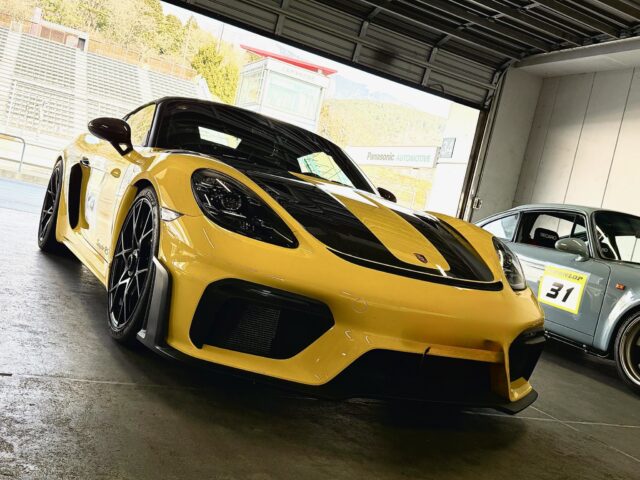
Taking the 718 Spyder RS Around Fuji Speedway [6:55]
- We took the 718 Spyder RS to a track event at Fuji Speedway. As we also wrote in a blog post, it’s perfectly at home on track—and even with the soft top up, driving at over 200 km/h wasn’t a problem.
- The most moving part was the sound of the GT3 engine. Braking from fifth or fourth gear and letting the PDK shift down automatically produced an incredible soundtrack. Even through a helmet, it was absolutely wild—good enough to make you want three bowls of rice just to keep listening.
- Mina, on the other hand, finds the Spyder RS’s sound too intense and tiring. The 981 Boxster has a thrilling sound, but the Spyder RS’s sheer volume and intensity are on another level. On a racetrack, though, the contrast between accelerating and braking might make it a different experience.
- At high speeds, the soft top billows quite a bit. There was enough space between the carbon panel and the fabric roof to fit a hand, and it was already puffing up at 120 km/h. The car was designed to reach its top speed with the roof off, so it’s really meant to be driven without the soft top fitted.
- Among 58 cars at the track event, the Spyder RS clocked the fastest time. It’s a car that even an amateur can drive quickly, with enough performance to chase down a GT3 RS.
Precise Handling and Cornering in the Spyder RS [16:49]
- Entering Fuji’s first corner at 65–70 km/h, the car responded precisely to every steering input. It neither drifted wide nor tucked in too sharply. The heavier Turbo GT struggles more here and feels as if it might run wide.
- Through the 100R corner, the Spyder RS felt composed and had plenty in reserve at speeds above 130 km/h. In a 981 Boxster, body roll becomes more pronounced around 120 km/h, which can feel unsettling; the Spyder RS still felt ready for more.
- It also handled the quick, chicane-like changes of direction at the Dunlop Corner beautifully. Lift off the throttle, turn the wheel, and the car changed direction in an instant. Overall, it felt light on its feet and easy to drive smoothly, with less fatigue than expected—and it was even more relaxing than the Turbo GT.
Now We Want a GT4 RS—and a Word on Dunlop Tires [22:29]
- After driving the Spyder RS at Fuji, we really wanted a GT4 RS as a dedicated track car. Without the limitations of a soft top and with a rear wing, it should feel even more stable. The standard bucket seats would be enough—we wouldn’t need the Weissach Package or PCCB carbon-ceramic brakes.
- Even with a GT3 engine, the 718 models feel more analog and companionable than the 992. Their engineering builds on the 981, giving them a human warmth that’s different from the near-perfect refinement of the latest 992.
- The car was fitted with Dunlop Sport Maxx Race 2 tires, which made a great impression. Compared with Michelin Cup 2s, they seemed less prone to heat-related performance drop-off, with much less of that squirmy feeling late in a 30-minute session. Grip was strong, too, and there was still room to push harder.
Long-Distance Driving in the Taycan—Without Losing Time to Charging [31:48]
- We made the trip to Fuji in two cars: a Taycan Cross Turismo 4S and the Spyder RS. The Spyder RS has poor fuel economy and a small tank, so even with a full tank it can only cover about 500 km, making a fuel stop necessary.
- The Taycan’s battery was down to 22% around Hamamatsu after leaving Kansai. A charge during lunch brought it back into the 70% range. At the hotel, we simply plugged it into a 200V AC charger, and by the next morning it was over 80%. We didn’t need to set aside any extra time just to charge.
- Even after replenishing the energy used during the drive, charging overnight at the hotel cost only about ¥1,100. The huge savings on energy and the time saved are major advantages. Even an early-generation Taycan can comfortably make it from Kansai to around Numazu.
Japan’s Highway Charging Stations Leave a Lot to Be Desired [36:18]
- The Taycan’s charging capability is not the problem; Japan’s CHAdeMO chargers along expressways are. Each time, you have to scan a QR code with your phone and enter your address, name, and card details—and errors are frequent. If something goes wrong, you have to enter everything again from the beginning.
- The LCD screens are often sun-damaged and impossible to read. You may even be charged an initial fee when a session fails. The cables are incredibly heavy—too heavy for many older drivers to handle. They’re impossible to manage with one hand; plugging one in feels like a firefighter wrestling with a hose.
- With a Tesla Supercharger, you just press the button and plug in the cable. The cable is thin and light, and there’s no need to enter credit card details. The difference feels like a reflection of whether the people who designed the system actually drive EVs themselves.
Tesla Model YL Launches—and Hiro’s Brother Orders One Right Away [41:19]
- The six-seat Tesla Model YL has launched. It weighs around two tonnes and can sprint from 0 to 100 km/h in about five seconds, making it seriously quick. Hiro messaged his younger brother first thing on April 3 to tell him it was available, and the order was placed in under 30 minutes. It may have been one of the earliest orders in Japan.
- His brother has recently become a Porsche fan, too—he even drives his GT3 Touring up to Rokko. He fell in love with Tesla after driving one in Hawaii and had been planning to buy a Model Y after returning to Japan, but decided to wait after hearing rumors about the Model YL.
- Government incentives bring down the price, and the car also comes with three years of free Supercharging. It’s well equipped for family use, with ventilated seats, heated seats, power reclining, and power-folding seats all included as standard.
Considering a Switch from the Taycan to the Model YL [44:41]
- Hiro often parks in coin-operated lots for work in central Osaka, so the 1,850 mm-wide Model 3 is easier to maneuver and he plans to keep driving it. But Mina started saying, “This is great—let’s get one. Let’s sell the Taycan and get this.”
- Mina is fed up with their three kids arguing in the back of the Model 3 or Taycan: “It’s cramped,” “Stop kicking me.” With the Model YL, two children could sit in the second row and one in the third, which might put an end to the squabbling.
- The Taycan’s trade-in value would be terrible, Mina thinks. One drawback of the Model YL is its 6.3 m turning circle, which makes tight turns more difficult. We’ll share a detailed review once her brother’s Model YL arrives.
How Full Self-Driving Could Change the Way We Tour [53:47]
- Once FSD is available, Hiro thinks he’ll drive his Model 3 to Tokyo for work trips instead of taking the Shinkansen. Considering the hassle of getting to Shin-Osaka Station, he’d rather let FSD handle the drive while he relaxes. He could use the time in the car to give work instructions to AI tools such as Claude.
- It could also change the way we go touring. Until now, a driving trip has usually been about the roads and the drive itself; with FSD, it could become more about enjoying the scenery and exploring towns. When we tried FSD in the U.S., we were able to look around and take in the views.
- Mina already opens her laptop and joins meetings from the passenger seat of the Taycan, and a Tesla would make that even more comfortable. With Tesla’s Camp Mode, the air conditioning can stay on, making it well suited to getting work done in the car.
このブログが気に入ったらフォローしてね!
コメントを閉じる
Comment ( 0 )
Trackbacks are closed.
No comments yet.