

How to Properly Inflate Porsche Tires (Models with TPM)
Published: 2018.08.17

コンテンツ
Porsche Tire Pressure Monitoring: What TPM Does
Today, I’m taking a look at how to properly inflate your Porsche’s tires. This guide is specifically for models equipped with a Tire Pressure Monitoring (TPM) system.
TPM is fitted to Porsche models from the 997 generation onward. It displays the pressure in each front and rear tire on the instrument cluster. The system is designed to help keep you safe by detecting and warning you about gradual pressure loss, whether from normal air seepage or a foreign object embedded in a tire. (It cannot detect or warn you about a sudden pressure drop, such as a tire puncture caused by an abrupt external impact.)
For this guide, I’ll use our 971-generation Panamera as an example.
Comfort or Standard Tire Pressure?
Before inflating your tires, there’s one thing to check: which pressure mode you want your Porsche to use—“Standard” or “Comfort.” Dealers often set one of these modes before delivery, so it’s worth checking and choosing the one that suits your preferences. Here’s the difference:
■ Standard pressure: The usual Porsche setup, with a slightly firmer ride
■ Comfort pressure: A slightly lower pressure for a softer ride and improved comfort
On the touchscreen, go to “Vehicle → Vehicle Control → Tire Pressure Monitoring.” Select “Comfort Pressure” to use Comfort mode, or deselect it to return to Standard mode.
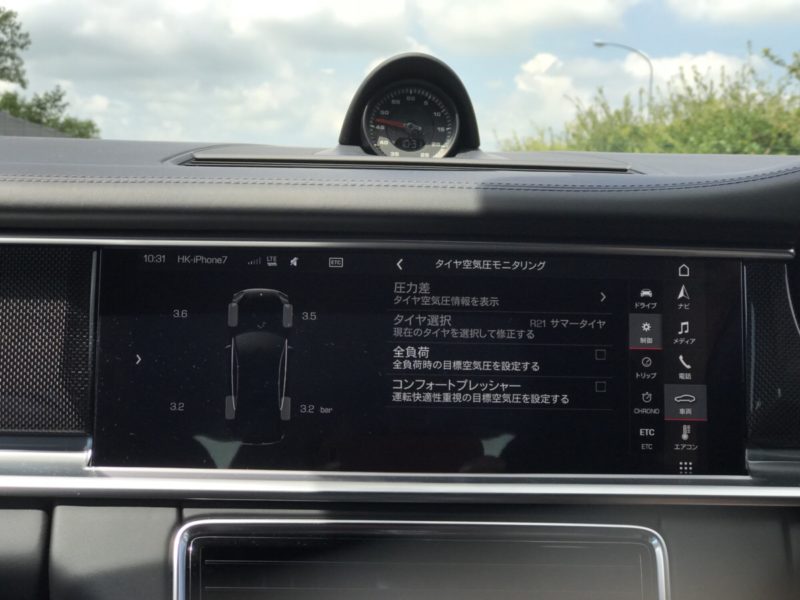
One important point: in Japan, Comfort pressure is only approved for speeds up to 160 km/h (99 mph), so the system will issue a warning if you exceed that speed. (In Germany, the limit is 270 km/h; the Boxster is also set to 270 km/h in Japan.) You may never drive faster than 160 km/h on Japanese roads, but if you’d rather avoid repeated warnings, Standard pressure may be the better choice. We prefer a firmer ride, so our car is set to Standard pressure.
How to Inflate Porsche Tires Correctly
When inflating your tires, you’ll refer to the tire pressure display on the instrument cluster—but there’s an important catch. Don’t adjust the pressure based on the “Current pressure” reading. For example, if you want 2.5 bar and the display reads 2.2 bar, don’t simply add 0.3 bar.
That’s because the “Current pressure” reading doesn’t account for tire temperature. (The specified tire pressure is based on cold tires at 20°C.) Most of us drive to a gas station before topping up, but driving heats the tires and increases the pressure. If you inflate them while they’re hot, the pressure may be too low once the tires cool down.
The Panamera owner’s manual puts it this way:
The pressure shown under “Tire Pressure → Current Pressure” is for information only. Tire pressure varies with temperature. Never adjust tire pressure based on this reading.
So what should you use instead? Check the “Pressure deviation” reading in the Tire Pressure menu. It accounts for tire temperature and shows how far each wheel is from its specified pressure.
.jpg)
In the image above, the right-rear wheel shows “−0.1 bar.” In other words, add 0.1 bar to the right-rear tire. Adjust the pressure using these readings until all four tires show “0.0 bar.”
If you ask a gas station attendant to inflate your tires, don’t say, “Set it to 2.8.” Instead, tell them, “Please add 0.3 bar.”
How Tire Pressure Changes the Way Your Porsche Drives
After inflating the tires this way, I took the car for a drive and immediately noticed how much lighter the tires felt and how much lower the rolling resistance seemed. On rough roads, the ride could feel a little bouncy, but on smooth pavement the car rolled along effortlessly. Through corners at a brisk pace, the tires felt planted, with little sense of flex. My husband said:
“Come to think of it, when we took delivery of the Boxster, our dealer contact, H, told us, ‘When adjusting tire pressure, always use the readings in the car—not the gauge on the air pump.’ So that’s what he meant! This is really important!”
The owner’s manual recommends checking tire pressure at least every two weeks, when the tires are cold. We check ours about once a month, but pressure tends to drop more quickly in summer, so regular checks are a good idea.
And yet, despite writing all this like an expert, I’ve never inflated a tire myself. (At the gas station, my job is to tell my husband, “Add another 0.1! Oh, too much—you’re 0.1 over now!” lol.) Maybe it’s time I learned to do it myself.
If you enjoy this blog, follow along.
Comment ( 0 )
Trackbacks are closed.
No comments yet.