

Porsche 911 GT3 R Wins Overall at the 2018 Nürburgring 24 Hours!
公開日:2018.05.14
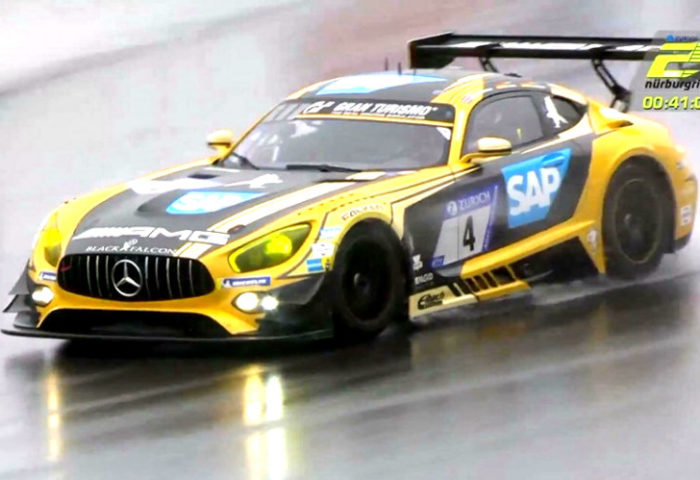

*I forgot to take a photo of the Porsche itself, so the featured image is a Mercedes-AMG GT3 my husband photographed.
What Is the Nürburgring 24 Hours?
Last weekend, the Nürburgring 24 Hours endurance race took place at the Nürburgring in Germany. The “Nür” in today’s title is short for “Nürburgring.” Held there every year in May or June, the race is all about covering as much distance as possible in 24 hours.
Cars are divided into classes according to engine size and type, and an impressive 156 cars reportedly entered this year.
It was rainy in western Japan over the weekend—and pouring in Germany, too. (I’m a bit of a storm magnet, so my husband joked, “Maybe it’s raining in Germany because Mina’s watching the race.” (-_-)) The race was hard to predict, with a red flag brought out by dense fog around the halfway point and plenty of cars spinning out. In the end, the Porsche 911 GT3 R took the overall win.
Subaru and Toyota (Lexus) also competed from Japan, with Subaru winning the SP3T class.
The Nürburgring is apparently considered a mecca for racing fans. Curious about why it carries so much weight, I did a little digging.
A Circuit with More Than 90 Years of History
The Nürburgring is a circuit in Nürburg, in the state of Rhineland-Palatinate in northwestern Germany. It opened in 1927, giving it more than 90 years of history. But this isn’t the kind of circuit most of us picture, with grandstands and a clear view of the entire lap. This track winds through a forest.
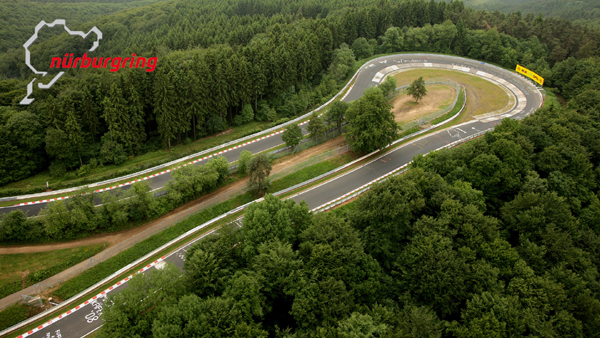
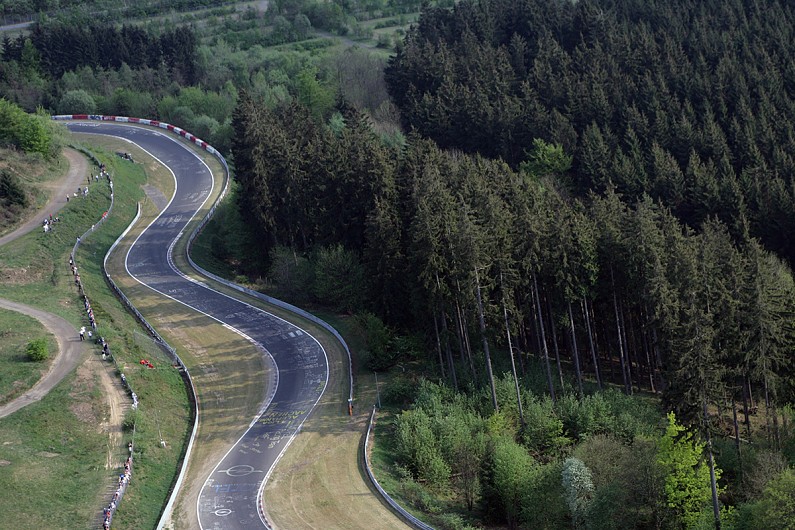
Even more astonishing, the Nordschleife, or North Loop, is about 20 kilometers long.
The Nürburgring 24 Hours uses a combined layout linking the North Loop with the 5.1-kilometer Grand Prix circuit, making the full course a staggering 24 kilometers long.
For comparison, one lap of Osaka’s JR Loop Line is reportedly 21.7 kilometers—so this is an even longer circuit…!
A race track longer than a circle drawn with Tennoji at its center and Osaka as its diameter… Germany really went all out (;´д`).
The North Loop is known as the “Green Hell,” and it’s an exceptionally challenging circuit where many people have been killed or injured over the years. Ten laps here are said to put as much strain on a driver as covering 800 kilometers on public roads. It’s such a formidable course that building anything like it today would be unthinkable. It has more than 170 corners and around 300 meters of elevation change.
To put 300 meters in perspective, that’s the height of Abeno Harukas in Osaka, Japan’s tallest skyscraper.(Though for some reason, I’d imagined Abeno Harukas was around 600 meters tall.)
Source: “Nürburgring Basics: What Is the Nürburgring?” from TOYOTA GAZOO Racing
Why Automakers Test Their Cars at the Nürburgring
Because the circuit is so demanding, Porsche, Mercedes-Benz, BMW, Audi, and other automakers use it to test and fine-tune their cars.
A car that sets the fastest lap at the Nürburgring earns bragging rights as the “world’s fastest production car,” boosting the image of both the vehicle and its manufacturer.
Our Panamera Turbo also set a remarkable time of 7 minutes 38 seconds on the North Loop in 2016, becoming the world’s fastest sedan at the time. Even if—just hypothetically—someone paved over Osaka’s JR Loop Line and said, “It’s just a flat circle with no hills or corners, so take the Panamera Turbo around it flat out!” I still can’t imagine doing it in seven minutes… (LOL)
Then, last April, a Porsche 911 GT3 RS clocked an astonishing 6 minutes 56.4 seconds. It was reportedly only the third Porsche production car to break the seven-minute mark. Porsche fans pay close attention to how quickly a new Porsche completes a Nürburgring lap, and news of a new record is often widely shared.
Not Just European Cars: Japanese Models Take on the Nürburgring, Too
It’s not just German cars. Nissan’s Skyline GT-R and Honda’s NSX reportedly began testing at the Nürburgring around 1990. Subaru, which won its class this year, has entered the Nürburgring 24 Hours every year. Competing and winning in this race can be enormously valuable publicity.
“In fact, the WRX STI S207, a limited-edition complete car developed by STI, sold out all 400 units on its first day. That’s a Japanese car costing six million yen. The Nürburgring really does have a huge impact.”
Wait—!
Four hundred cars costing six million yen each, sold out in a single day…! (;゚Д゚)))
Wow, the Nürburgring really does have a lot of influence.
Source: Why Does Subaru Keep Taking on the Nürburgring 24 Hours?
Calling It “The Nür” Is How You Know Your Stuff
I’m a beginner, so I stumble over “Nürburgring” every time I say it. But people in the know apparently call it “the Nür.” Sure enough, during yesterday’s race, the commentators and drivers all used that shorthand.
Learning more about the Nürburgring makes me want to drive it for myself.
The Nürburgring is a toll road, and for around €25 per lap, you can reportedly borrow everything you need, including a helmet. Anyone with a valid driver’s license can drive the track. But with my driving skills, there’s no way I’d be able to truly experience the Nürburgring behind the wheel. Fortunately, there’s also something called a “circuit taxi,” which lets you experience the track from the passenger seat with an experienced driver.
And these aren’t ordinary taxis—you can ride in a BMW M car or a Porsche Cayman. That sounds like an incredible experience!
Wow, I really want to go back to Germany!
このブログが気に入ったらフォローしてね!
Comment ( 0 )
Trackbacks are closed.
No comments yet.