

Is Porsche Getting Ready to Launch a Cayman T? A Look Back at the Original Cayman’s Specs and Reviews
Published:


Porsche Cayman
The other day, I came across an online news story saying that Porsche was preparing to launch a new 718 Cayman T. My first thought was, “So it’s not just the 911 getting a T model—the Cayman could get one, too?” Then I realized something…
There isn’t a single article about the Cayman on this blog.
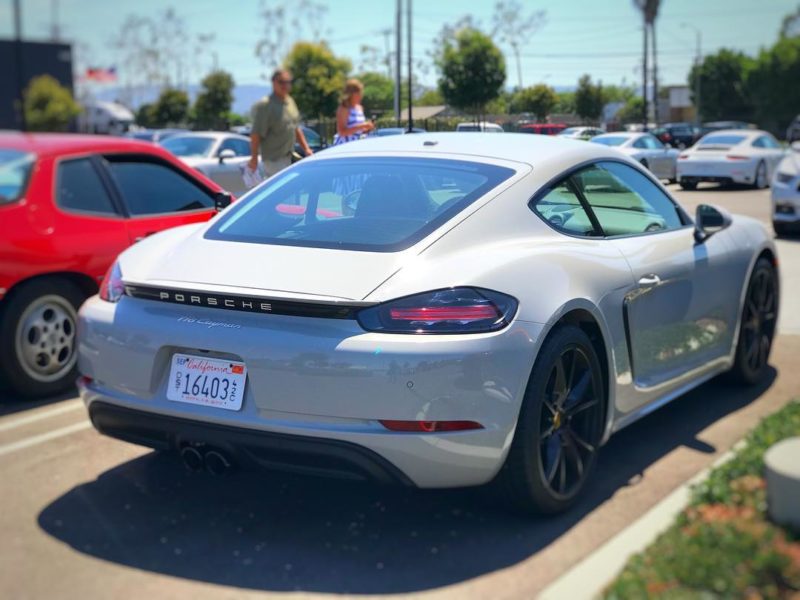
I publish articles every day, so why have I never written about the Cayman? There’s no deep reason. I’d actually like to feature one, but nobody around me owns a Cayman, and I haven’t had the chance to get behind the wheel—so it just never happened. Before I started this blog, my husband did get a brief test drive in an acquaintance’s Cayman GTS. But when we met that owner again recently, he had switched to a 911.
So I decided this was the perfect opportunity to look into the Cayman’s history and how it has evolved since its debut. The research turned up an enormous amount of information (no surprise there), so for now, I’ll focus on the original Cayman’s specs and reception, and give you the big-picture overview. I’ll do some research on the 718 Cayman and write about that another time.
The Cayman Debuts in 2005
The Cayman is a coupe derived from the open-top Boxster (Type 987), and it made its debut in 2005 as the Cayman S. Its name comes from the caiman, a reptile in the alligator family.
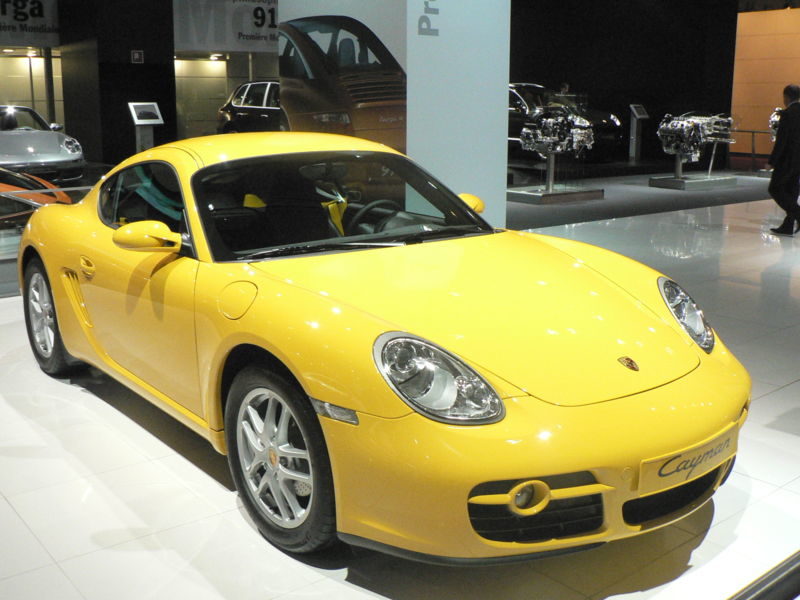
*Image source: Wikipedia, “Porsche Cayman”
As a Boxster-derived model, the Cayman shares its basic layout:
・Two seats
・A horizontally opposed engine
・A mid-engine, rear-wheel-drive layout
Unlike the open-top Boxster, however, the Cayman has a fixed roof. When it launched, its torsional rigidity was set at twice that of the Boxster.
When it came to performance, though, Porsche followed the principle that “the heart and soul of Porsche is the 911.” The Cayman was powered by a 3.4-liter engine based on the Boxster’s, but with a larger bore and cylinder heads and a crankcase from the 911 (Type 997).
And yet, prices started in the ¥6 million range. That made it a pretty tempting deal.
At the time, many articles compared the Cayman with the 911. On paper, the Cayman looked like the better buy:
・The Cayman was about 100 kg lighter than the 911.
・Its mid-engine layout made it easier to drive than the rear-engined 911.
・With two seats, the Cayman offered more luggage space than the 911’s 2+2 layout, making it more practical for everyday use.
・It cost far less than the 911.
But after taking both cars out for a drive, most reviewers gave the 911 the edge, saying it simply felt more like a Porsche.
It’s often said that, in a sports car, a mid-engine layout is fundamentally better than a rear-engine one. The Cayman was also lighter than the 911, but it still didn’t beat the 911’s lap times…
That was because the 911 remained the model above the Cayman in Porsche’s lineup. The Cayman’s performance was apparently deliberately limited; for example, its engine was tuned so it wouldn’t outperform the 3.6-liter engine in the 911 of the time.
The Relationship Between the 911 and the Cayman
As I sorted through the information about the Cayman, I started to feel a little sorry for it (-_-). No matter how you look at it, Porsche has always revolved around the 911.
It reminds me of two sons born into a samurai family during Japan’s Warring States period: the younger brother can never surpass his talented older sibling, and no matter how hard he tries, it’s the eldest son who inherits the family legacy. Okay, I may be taking the personification a bit too far… lol (In 2015, the Cayman GT4 finally beat the 911 of the time on a circuit lap.)
The Cayman later underwent a full redesign as part of the 718 range, evolving further—and now there’s even news that a Cayman T could be on the way.
The Cayman has also reportedly been selling well. In 2017, global sales of the 718 Cayman and 718 Boxster totaled 25,000 units, up 6% year on year. Impressive!
*Porsche Sets Another New Sales Record in 2017
The Cayman: The Best of Both Worlds
The more I read about the Cayman, the more I came to see it as a Porsche that brings together the best of the Boxster and the 911 at an attractive price.
It’s a two-seater with a mid-engine layout, giving it a good weight balance for a sports car. Unlike the Boxster, it has a fixed roof for added rigidity, offers a decent amount of luggage space in its front and rear trunks, and—at least in base form—costs about half as much as a 911.
The Cayman is often called an entry-level Porsche, and it’s easy to see why many people think, “The 911 is expensive and looks difficult to handle, so maybe I’ll start by buying a Cayman.”
The one thing I’m not entirely sold on is the Cayman’s rear design. It’s certainly attractive, but when I compare it side by side with the 911, I can’t help feeling that it falls short of the 911’s elegant, refined looks (Is that part of Porsche’s strategy?).
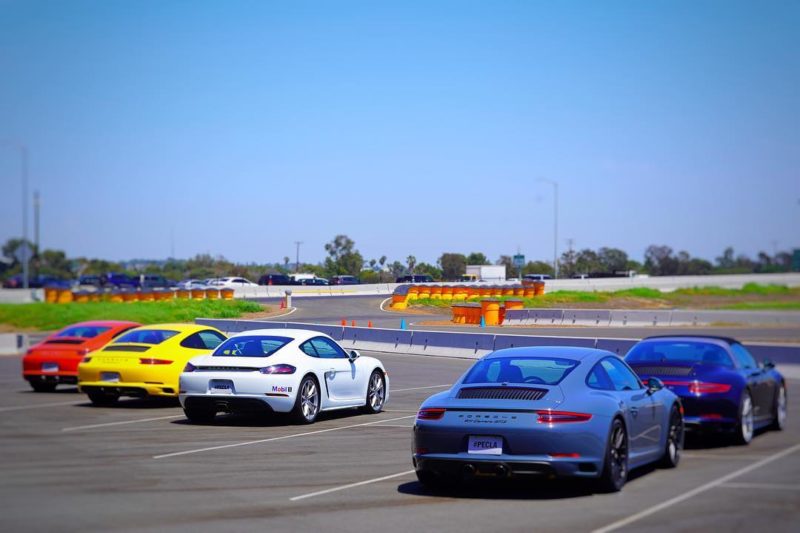
I love the 911’s rear design. My husband and I were even saying how much better our current Panamera looks now that it’s closer to the 911’s styling! So that’s the one little thing that gives me pause.
I know I’m talking big, considering I’ve never even ridden in the passenger seat of a Cayman—but I’d love to experience one. I wonder if someone I know will bring their Cayman to the Royu Driveway sometime (haha). A reader also asked me to write about the differences between the Cayman and Boxster, so I’d like to cover that one day, too.
If you enjoy this blog, follow along.
Comment ( 0 )
Trackbacks are closed.
No comments yet.