

Are Porsche’s Published Figures Really Accurate? Testing the Panamera with *Car Graphic*
公開日:2018.04.09
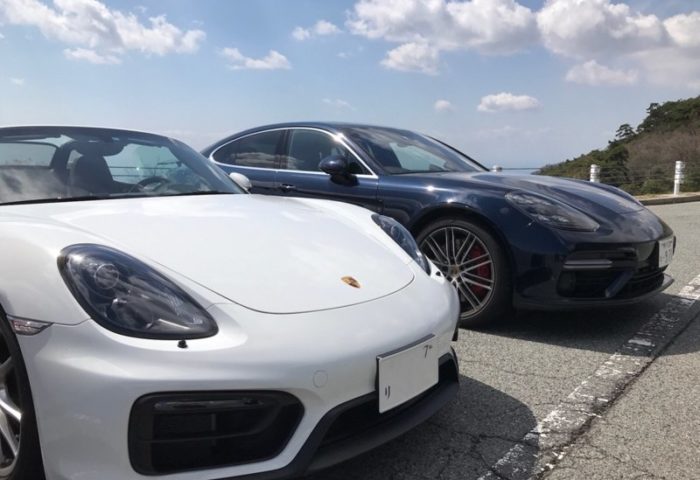

Porsche tests its cars in the extreme heat of Death Valley
The other day, I came across an article titled “The Porsche 911 GT3 Doesn’t Have a Turbo or Hybrid System Because Customers Don’t Want One.” It included this passage:
The GT3 is the only car in Porsche’s current lineup without a turbocharger. Its naturally aspirated 4.0-liter flat-six produces an impressive 520 PS (according to Preuninger, that figure was recorded in the scorching summer heat of Death Valley; under more moderate conditions, it would produce a little more power).
So Porsche tests its cars in Death Valley in the height of summer. Interesting.
I mentioned it to my husband, and he said:
“That’s right. Porsche bases its published figures on tests conducted in Death Valley, so it keeps the numbers conservative. That’s why when you actually buy and drive one, it often outperforms the figures in the brochure. With other manufacturers, it’s often the other way around: the published figures look better than what you get in real life.”
The proof? My husband dug out an old magazine
To prove his point, my husband pulled out an issue of *Car Graphic* that he’d ordered when he was considering buying a Panamera Turbo.
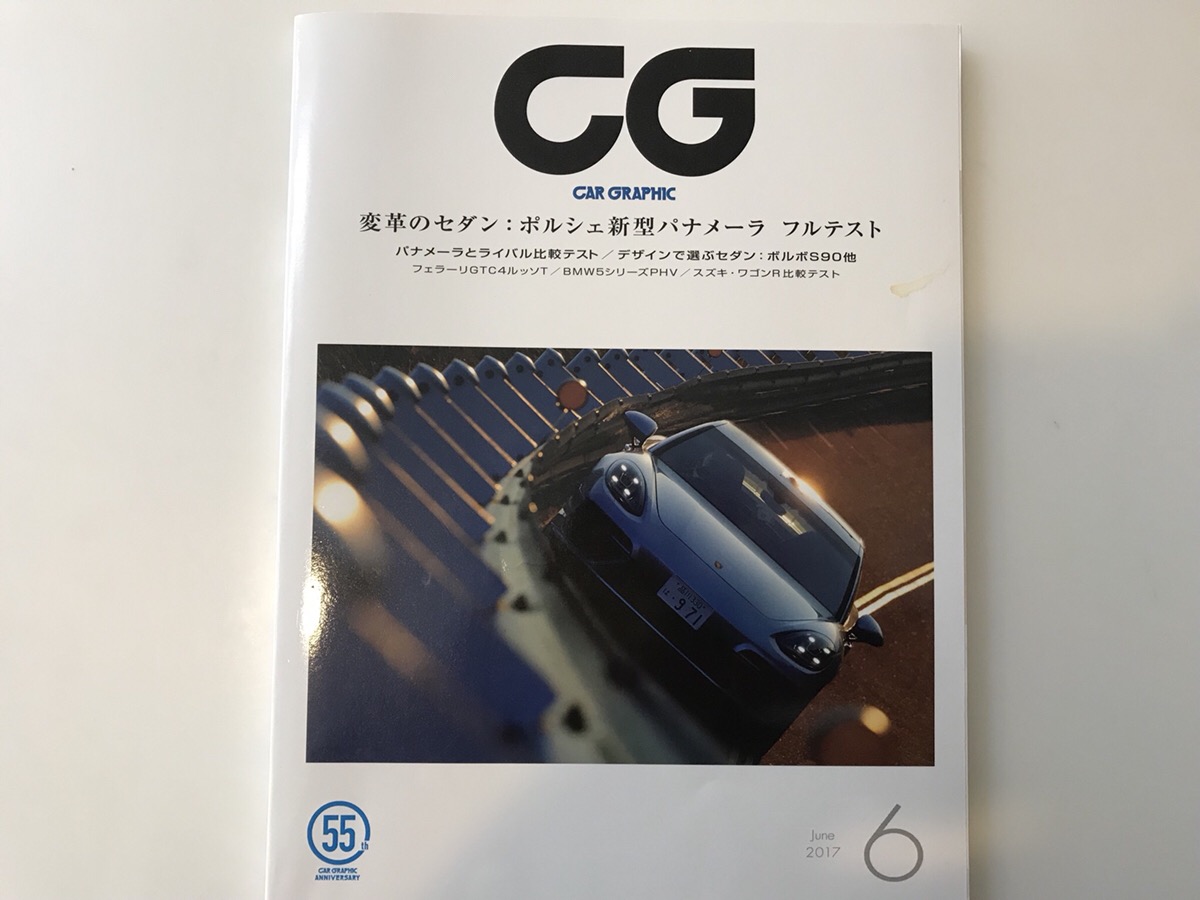
(“A Sedan in Transition: Full Test of the New Porsche Panamera—Panamera vs. Its Rivals / Sedans Chosen for Design: Volvo S90 and More,” June 2017 issue)
“Think I’m making it up? Read this—it’s all right here!” he said, handing it to me. It’s not that I didn’t believe him…but if he insists, I suppose I’ll take a look. (-_-)
The magazine’s test used a Panamera Turbo with the Sport Chrono Package. Turning the page, the first words to catch my eye were:
“What an incredible time to be alive.”
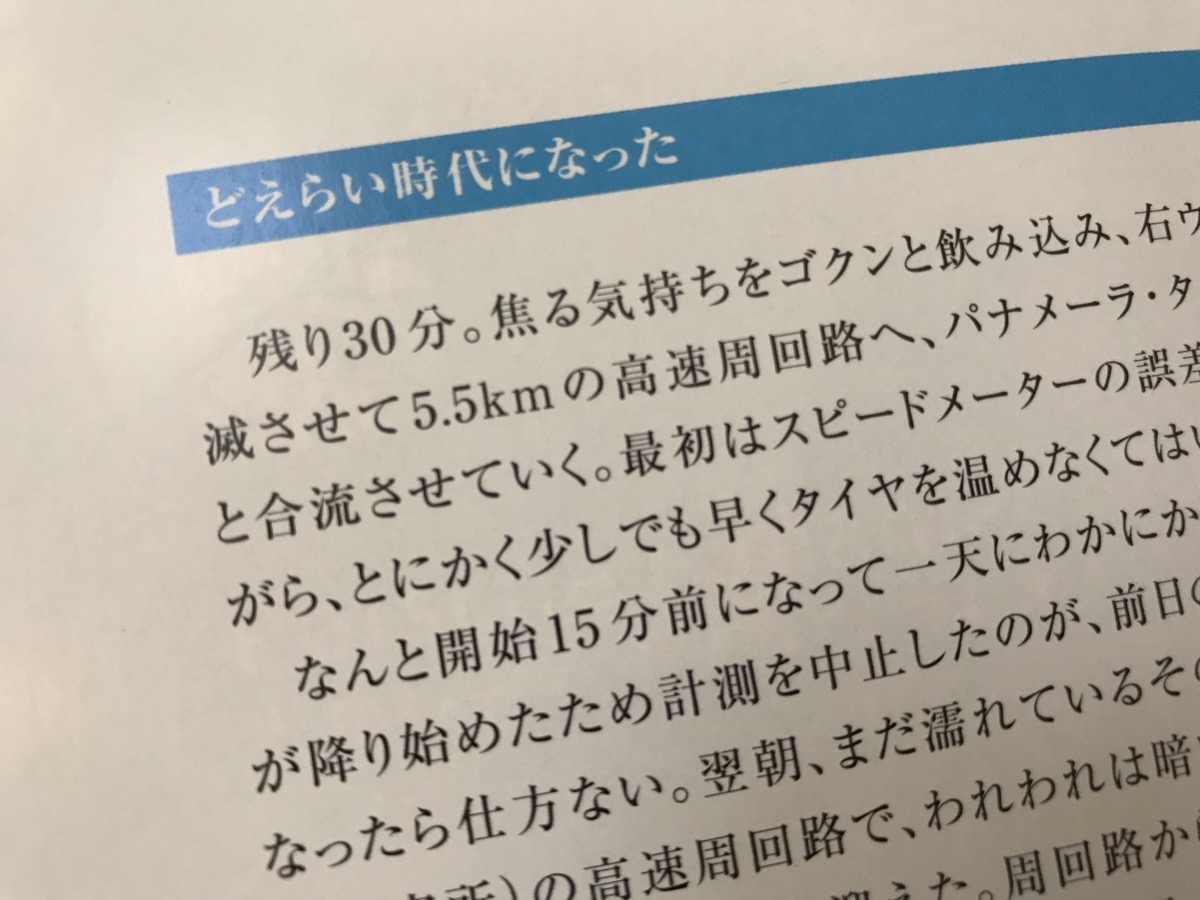 A *Car Graphic* writer saying “What an incredible time to be alive”—haha. That tells you just how impressive the Panamera must be. I was getting excited. Then I read on:
Just 15 minutes before the test was due to start, the sky suddenly darkened and large raindrops began to fall, forcing us to call it off. That was the previous evening. (Omitted) The next morning, on the still-wet high-speed oval at JARI (Japan Automobile Research Institute), we waited in the dark, gazing toward the eastern sky for sunrise. (Omitted) The track had finally dried enough for us to consider starting the measurements, with just 30 minutes to go.
In other words, conditions were far from ideal—in fact, they were pretty much as bad as they could get. They were only just able to go ahead with the test.
Back at the control room, we checked the data. All three 0–400 m runs came in around the mid-11-second range, with a best time of 11.42 seconds (0–100 km/h: 3.36 seconds; 0–1,000 m: 20.95 seconds). Porsche quotes 3.6 seconds for the 0–100 km/h sprint in the Panamera Turbo with Sport Chrono, so we were relieved to beat that figure.(*Note: The press materials list “0–100 km/h: 3.8 s (3.6 s with Sport Chrono),” but the current Panamera Turbo website no longer specifies a figure for the Sport Chrono version.)
“Relieved,” huh? Haha.
Well, it would have been awkward if the results from testing in Japan’s pleasant climate had been worse than Porsche’s Death Valley figures. Still, I wondered: “Doesn’t it take serious driving skill to do that? Was it another professional racing driver behind the wheel?” Then I read:
As long as you use launch control and floor the throttle, anyone can enjoy this level of acceleration without needing any special technique.(*Note: Launch control is an electronic system that helps a stationary car pull away quickly and smoothly.)
So even a nervous driver like me could get those numbers by working up the courage to floor it? The article goes on:
When we tested the 911 Turbo S (early 991 generation), its 3.8-liter twin-turbo flat-six (560 PS) covered 0–400 m in 10.90 seconds. The Panamera Turbo’s 4.0-liter twin-turbo V8 produces 550 PS, but the car weighs more than two tonnes—over 400 kg more—and stretches to more than five metres in length. To manage 11.42 seconds is astonishing. I doubt I’m the only one left open-mouthed.
Absolutely! ( ゚∀゚)・∵. And, as I read that, I realized my own mouth was hanging open.
What was the fuel economy with all that hard driving?
So, how did fuel economy look?
【Real-world fuel economy】
■ Overall average CG: 7.5 km/L Published figure: 9.4–9.3 L/100 km (10.6 km/L)
■ City driving CG: 9.2 km/L Published figure: 12.9–12.8 L/100 km (7.7 km/L)
■ Mountain roads CG: 5.3 km/L Published figure: N/A
■ Test course (JARI) CG: 4.7 km/L Published figure: N/A
■ Cruising at 100 km/h 13.1 km/L Published figure: 7.3–7.2 L/100 km (13.6 km/L)
*Total distance covered during the CG test: 1,371 km
Looking at the overall average, you might think, “Wait, the published figure is worse!” But considering the test included full-throttle runs at JARI and driving on mountain roads—conditions most of us rarely encounter—the result isn’t bad at all. And in city driving, the Panamera significantly beat its published figure.
Porsche really is something special
I knew Porsche’s published figures were conservative! Rather than putting some once-in-a-blue-moon best-case number in the brochure, it seems to publish “the minimum you can expect, no matter how you drive.” That feels like a perfect expression of the Porsche spirit. I love Porsche even more now—and I’m already itching to get behind the wheel of the Panamera again.
Maybe I’ll take it out somewhere tomorrow.
このブログが気に入ったらフォローしてね!
Comment ( 0 )
Trackbacks are closed.
No comments yet.