

[Live Stream Summary] Vol.112: Spider RS’s Long Touring to Shimokita Peninsula and Comparing the Early 991 GTS with the 3.4L Carrera
公開日:2026.05.14
Live Streaming

This article summarizes the recent live stream radio show, “Welcome Home, PORSCHE.”
Feel free to enjoy it during your commute, school runs, or as a driving companion in your Porsche.
If you like the content, please give it a thumbs up and subscribe to the channel!
コンテンツ
Key Topics and Highlights
Opening Update: Tesla Model Y Status [0:15]
- After a two-week break, the live stream kicks off. The chat mentions Portes-san’s upcoming delivery of a Spider RS in GT Silver.
- Hiro’s younger brother plans to purchase a new Model Y Long Range and will be test-driving it soon. A review is expected next week.
- Thanks to Tesla’s free software update, the immersive sound feature is now available, along with improved stoplight notifications and live camera functions, enhancing user experience.
- The Macan EV is also discussed—praised as a great vehicle with motor output characteristics completely opposite to Tesla’s.
Why the Spider RS Was Chosen for a 3,200 km Northern Japan Tour [4:34]
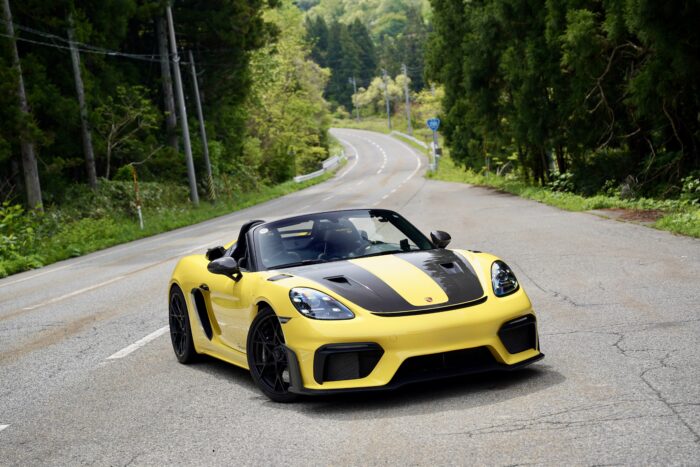
- From a lineup including Turbo S GT, 964, 981 Boxster, Spider RS, and SL400, the final pick was the Spider RS.
- Each car has a purpose: Turbo S GT dominates on highways, 964 suits running on local routes (national roads), Boxster is ideal for wider areas, and the Spider RS excels on mountain roads.
- The Turbo S GT was ruled out due to its 2-meter width, too wide for narrow roads. Having already taken the 964 and Boxster on long tours, the Spider RS was selected to explore uncharted territory.
- This journey was also a test: could the Spider RS handle a 3,000+ km long-distance tour?
Benefits of Bucket Seats: No Waist or Neck Fatigue [10:00]
- Despite covering 3,200 km, neither waist nor neck felt sore. The bucket seats felt like a “light corset” that firmly supports the body.
- Regular sports seats leave gaps between the backrest and body, forcing muscles to unconsciously tense to maintain posture—causing fatigue. The bucket seat eliminates that effort.
- Compared to the old GT3 with 18-way seats, where neck fatigue appeared even after short runs on the Ryujin Skyline, the Spider RS bucket seat is a different class.
- Lowering the seat fully allowed for ultimate relaxation, with minimal need to adjust posture even during long drives.
Road Surface Awareness Crucial in the Spider RS [13:08]
- The northern roads were rougher than Kansai, marked by patches, ruts, and spike tire traces, causing steering wheel wander and instability.
- The transition points between bridges and roads tend to dip slightly, leading to nose dives during braking that easily scratch the front lip.
- Falling rocks as large as fists caused serious scraping since the Spider RS’s low ground clearance touched both front and rear.
- The rear diffuser especially suffered scrapes. Even petrol station curbs required extreme caution. Although the impact was softer than a GT3, the low ride height demands constant vigilance of the road—a tiring but necessary focus.
Open-Air Driving and the GT3 Engine’s Intake Sound [18:14]
- Over 90% of the tour was completed with the roof down. Even at convenience stores and roadside stations, the roof remained open while quickly handling errands.
- Equipped with cup-tire style shallow grooves, a rainy day in Iwate led to an unplanned rest day at the hotel to work without driving.
- The microphone couldn’t fully capture it, but the live sound was as powerful as a race car’s.
- No valve controller was installed—this sound is pure stock, with negligible variation between sports exhaust ON/OFF depending on RPM.
- The loudest sound emerged with the roof attached but only the rear glass removed, an unexpectedly noisy configuration.
Shimokita Peninsula, Oma, and Osorezan Route Hits the Mark [33:09]
- First time visiting Shimokita Peninsula—a big win. The Oma-Mutsu Strait Line (coastal road) ranked alongside Shikoku Route 55 for sheer driving pleasure.
- Oma, famed as a tuna fishing port, features impressive mansions scattered throughout, hinting at the prosperity brought by tuna fishing.
- Beloved Osorezan’s best access was via Minamikawa, favored for its breathtaking mountain scenery.
- Northeast Japan has wide roads and endless driving options. A candid confession: “I envy Porsche owners living in Tohoku.”
Common Porsche Owner Quirk: “Must Reach the End of Road Closures” [38:30]
- Other Porsche owners like Wata-san (Facebook) and Ikuro-san were driving in similar Tohoku areas during the same period.
- Even when confronted with “Road Closed Ahead” signs, they feel compelled to drive right up to the barrier. Reasons include verifying the closure and enjoying traffic-free roads.
- Law enforcement was seen once for speed cameras in urban areas and 3–4 times for stop sign enforcement in Iwate or Aomori.
Viewer Poll on Age Groups Ends in Friendly Chaos [41:50]
- Utilizing a new polling feature, viewers were asked about their age group.
- The ranges “20-30s / 30-40s / 40-50s / 50-60+” overlapped, making data aggregation impossible.
- Results suggested most viewers were in their 40s to 50s. A better poll structure will be tried next time.
Reunited with the Early 991 Carrera 4 GTS and Comparing with the 3.4L Carrera [46:59]
- The beloved 991 early Carrera 4 GTS, sold in 2025, was found nearby and visited along with its current owner, Masa-san.
- The key impression upon driving it again: “The exhaust note is brutally raw.” Where the Spider RS excels with intake sound, the 991 Carrera 4 GTS impresses through exhaust sound.
- A test drive in a red early 991 Carrera (3.4L / PASM + 19-inch wheels) revealed the 3.4L’s rev-happy nature perfectly suited to the road.
- On the other hand, the 3.8L GTS delivered thick torque even holding third gear wide open, clearly showcasing the 400cc difference.
- The driving dynamics contrast was clear: the 4WD GTS “sticks and corners,” while the RR 3.4L Carrera offers a light, nimble feel.
Wheel Size and Ride Quality: The Big-Wheel vs. PASM Discussion [54:56]
- Years of testing the same models in various wheel sizes reveal the big wheels give a “dense, refined feel,” while smaller wheels feel “light and agile.”
- Neither is objectively worse for ride comfort; they simply represent different ride “genres”—choose based on your preference.
- However, large wheels almost demand Porsche Active Suspension Management (PASM). Big wheels without PASM tend to cause unstable ride quality, giving a “not fully tamed” impression.
- For Macan or Cayenne, air suspension supports the big wheels effectively.
- The conclusion affirms Porsche’s thoughtful grade-by-grade personality differentiation. Curiously, there’s renewed interest in trying 997 and 996 models.
- Next week’s plan: a test drive report on the Model Y Long Range.
このブログが気に入ったらフォローしてね!
コメントを閉じる
Comment ( 0 )
Trackbacks are closed.
No comments yet.