

Normal 911 vs GT3: Which Is More Fun on Public Roads? My Answer Based on the “Total Amount of Fun”
公開日:2026.05.12

コンテンツ
A Reader’s Question Sparked This Article
This blog has received over 5,000 comments since its launch—many coming from Porsche owners and enthusiasts sharing honest opinions.
Among those, I’d like to dive into one theme inspired by a question from Kei, left on my advice article for prospective Porsche 911 GT3 buyers. He asked, “On public roads mostly driven at 60–70 km/h, like national highways and bypasses, would the normal 911 be more enjoyable?” I believe this is a fundamental question that many potential buyers wrestle with.
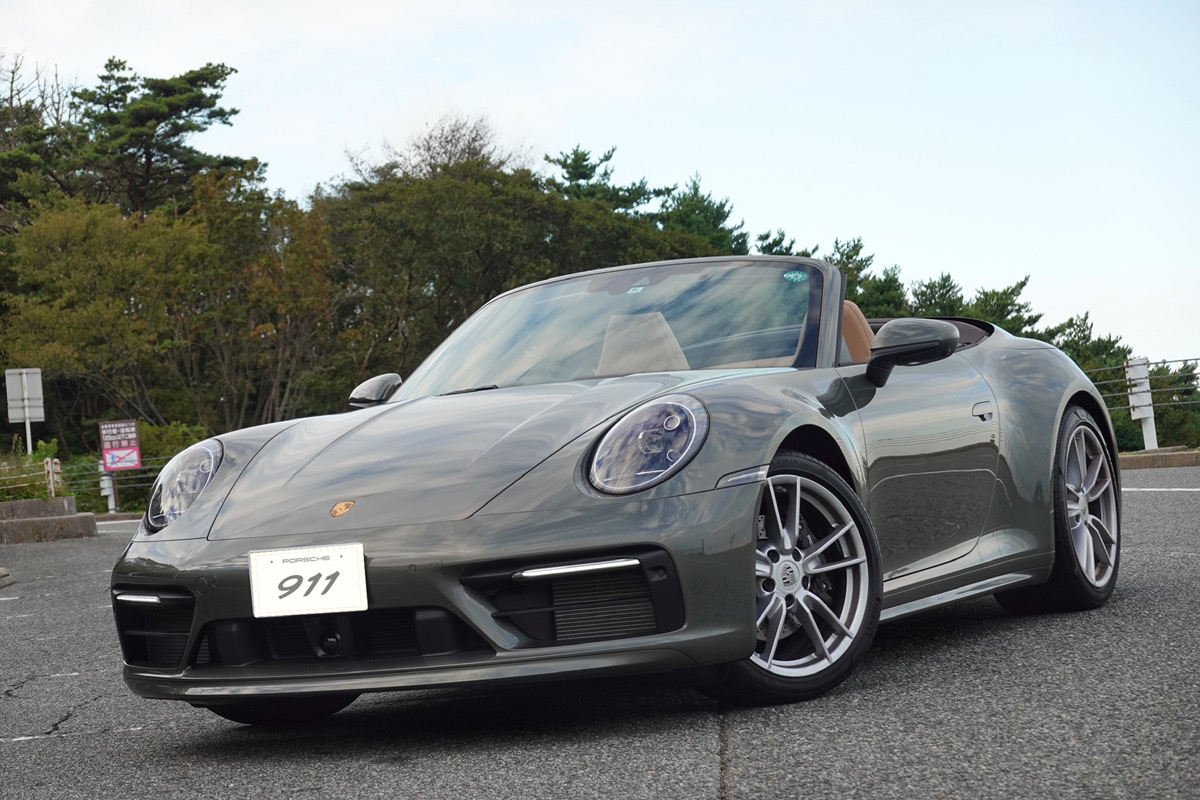
Having previously owned a 991.2 GT3 Touring, and currently driving the 718 Spyder RS, 981 Boxster GTS, and 964 Carrera 2, my clear answer to which is more fun on public roads is the normal 911. However, this requires a caveat: the GT3 is unquestionably thrilling when conditions are right. I’d like to organize my thoughts on this based on my own experiences.
In the City, the GT3 Is Nothing But a Pain
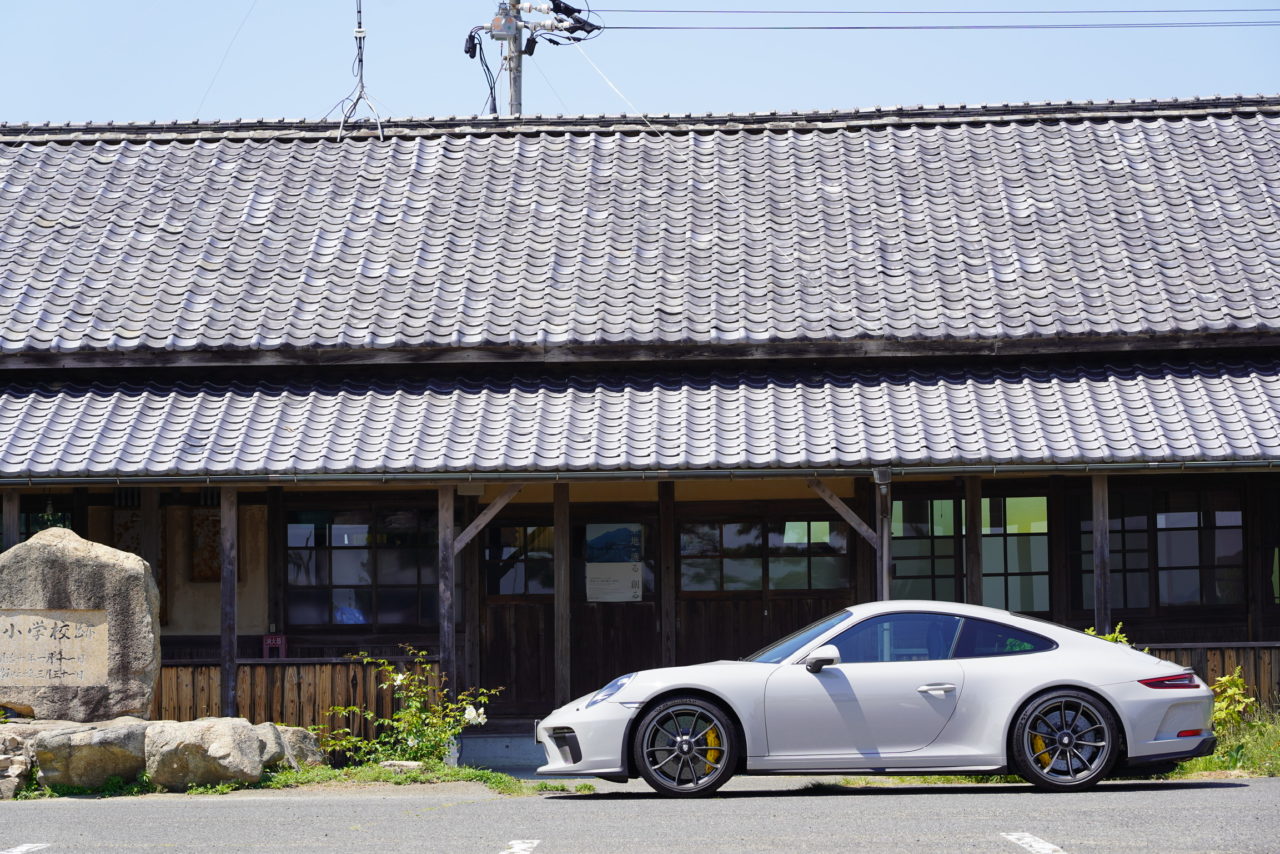
Driving a GT3 in Tokyo or urban areas is, to put it plainly, a painful experience.
This pain isn’t about ride comfort or a heavy clutch. It’s the frustration of not being able to unleash the car’s performance. Even when you want to hear that signature engine note, by the time you reach the rev range where the engine sings, you’re already going alarmingly fast for the city. That mighty engine ends up feeling like a “wasted lump” in town.
The suspension is similar. Even if you want to test the rock-solid cornering capabilities of the stiff setup, you never get the chance thanks to traffic lights and speed limits throughout city streets. When I drove my 991.2 GT3 Touring locally, I often caught myself wondering, “What am I even doing with this car?” If your joy is just the self-satisfaction of driving a GT3, that has its place—but in terms of truly experiencing Porsche’s essence, the GT3 in city traffic has almost nothing to offer.
On Well-Prepared Winding Roads, GT3’s Thrill Is in a Class of Its Own
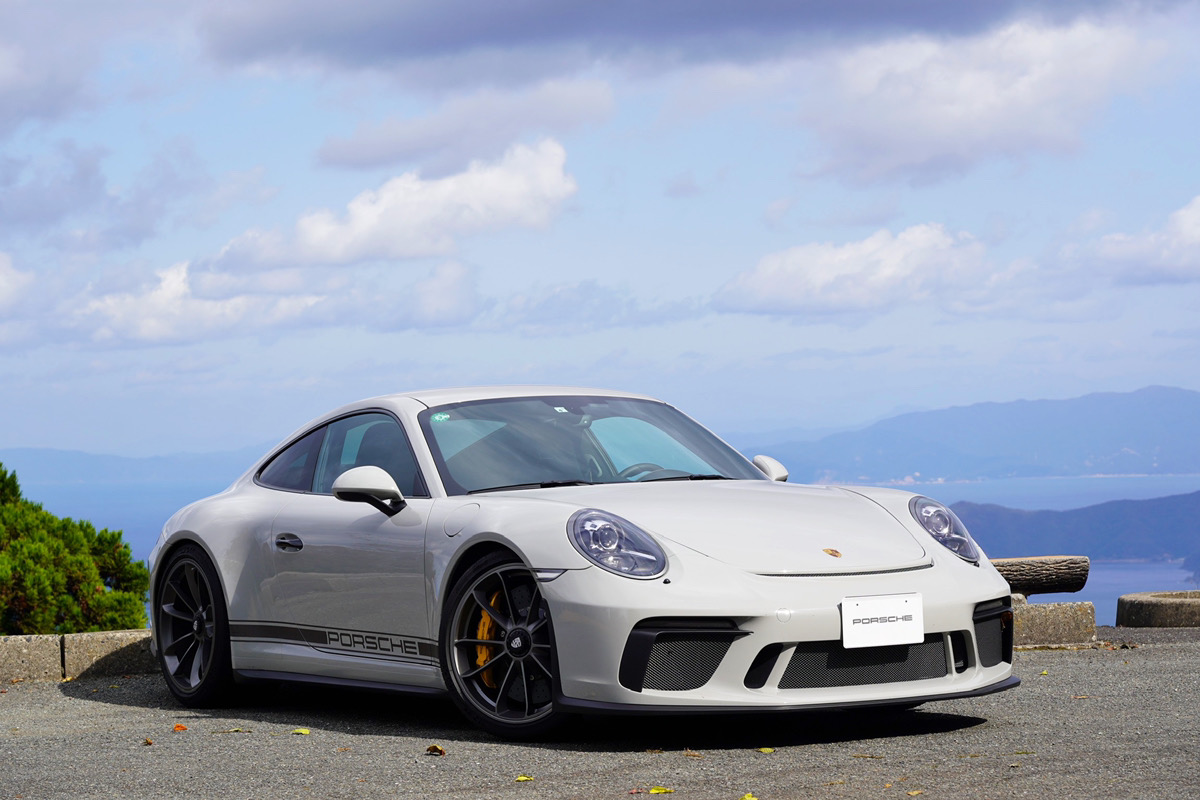
On the other hand, change the stage and the story reverses completely.
Early morning winding roads with light traffic, smooth surfaces, and open visibility—when all those conditions align, revving the GT3’s engine and nailing corners exactly as you envision sends your adrenaline far beyond what a normal 911 can deliver. The wealth of feedback through the steering, the way the suspension grips the tarmac, and the engine’s roar vibrating the air create a sensory experience that feels from a different realm entirely.
This, to me, captures the true essence of the GT3—a car for fleeting, intense bursts of excitement. The peak thrill it offers when conditions are perfect reaches heights utterly unattainable by a normal 911. Even after selling my 991.2 GT3 Touring, that split-second sensation remains vividly etched in my memory.
The Normal 911 Has the Strength of Being “Consistently Fun”
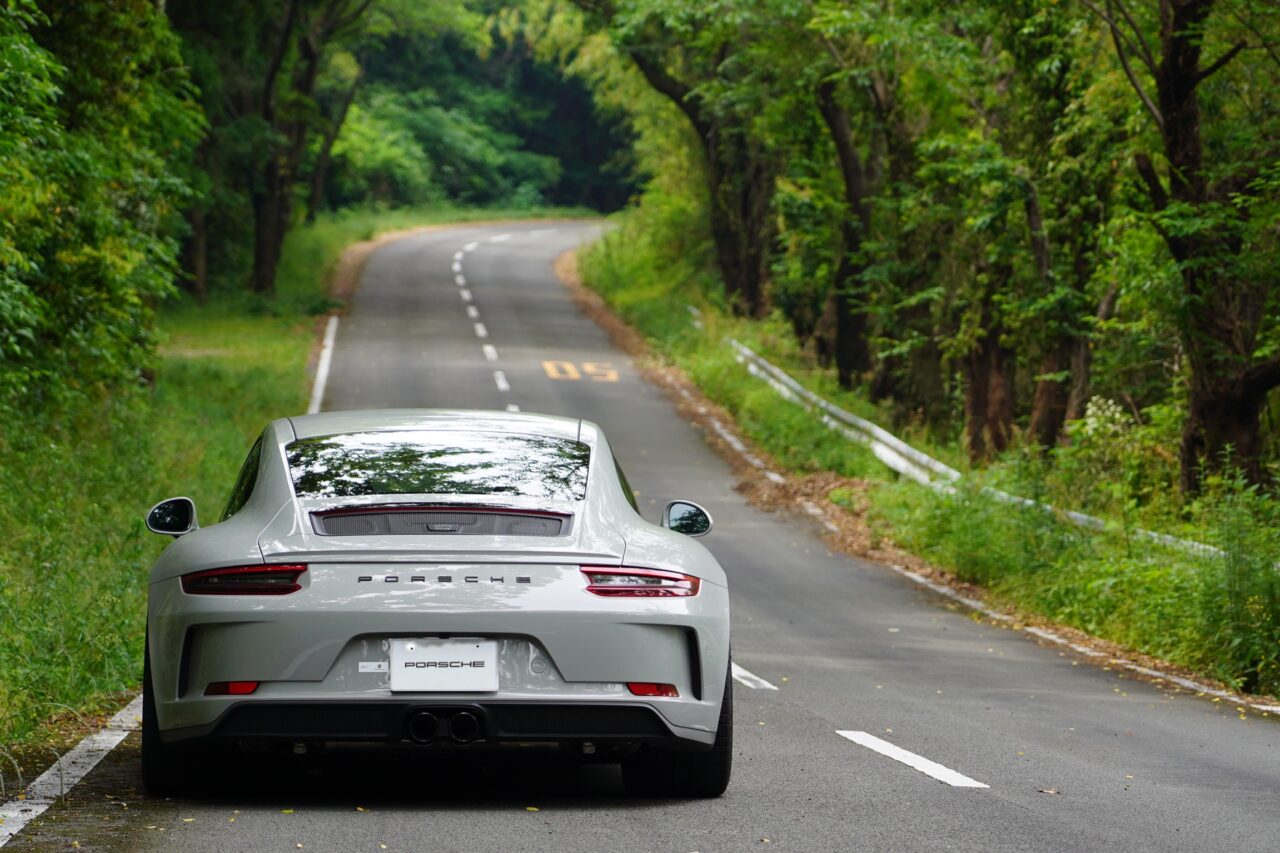
But what about the normal 911?
It shines equally across city intersections and winding mountain roads. From the moment you start it in a parking lot until you stop, there is always some pleasure to be found along the way. There may be no towering peak, but the baseline level of enjoyment stays impressively high. This keeps stress at bay and creates a feeling of, “I could drive this all day long.”
This is something I strongly felt when owning the 964 Carrera 2. It’s an old air-cooled 911, but whether sitting at a city light, flowing with traffic, or opening the throttle on a twisty mountain road, it delivers enjoyment that matches the moment without overwhelming the driver. The latest normal 911s carry forward this philosophy of “covering daily driving to extraordinary moments in one vehicle,” albeit with different character traits.
When Considering the Total Amount of Fun, the Graphs Just Differ in Shape
Lining up these perspectives reveals an interesting insight.
When looking at the total amount of fun, the GT3 and normal 911 might actually be more similar than expected. The normal 911’s graph is a high, flat line, while the GT3’s graph features sharp peaks in a few places. Although the shapes contrast, the area under each curve is roughly comparable. My answer to the comment was this: “If your driving mostly stays around 60–70 km/h, definitely the normal 911 is more enjoyable. However, the GT3 offers rare, intense highs that a normal 911 can never reach.”
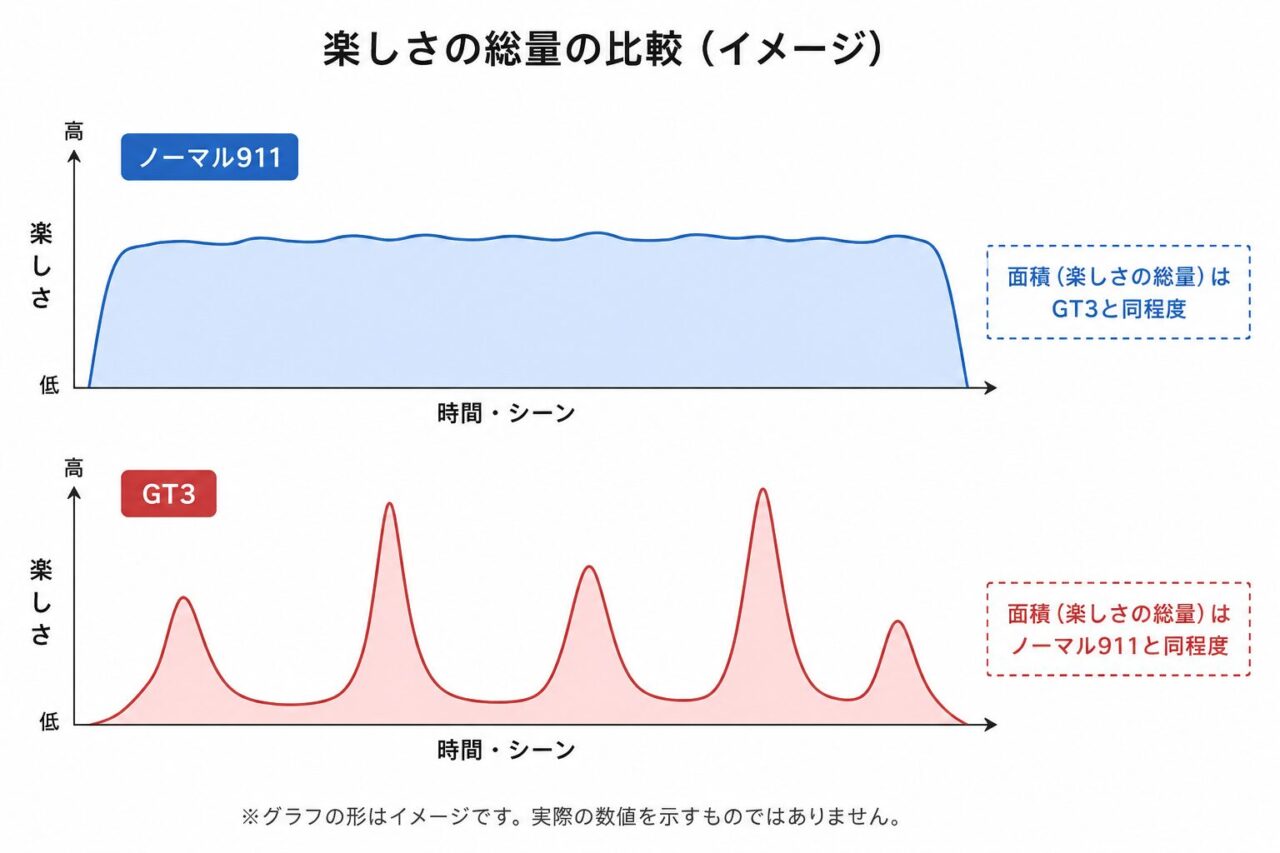
Ultimately, what you seek in a car changes the answer. If you want one car to enjoy from daily commutes to weekend drives, the normal 911 excels. If you want to experience fleeting, peak exhilaration a few times a month, the GT3 is your car.
Porsche brilliantly offers both answers. Remember, owning a top-tier Porsche doesn’t mean it covers all bases perfectly, and owning an entry-level one doesn’t mean it lacks excitement. Both can bring richly rewarding Porsche owner experiences depending on what thrills you the most.
このブログが気に入ったらフォローしてね!
Comment ( 0 )
Trackbacks are closed.
No comments yet.