

A Car-Loving Husband’s Guide to Breaking In a Porsche Panamera
公開日:2017.10.17
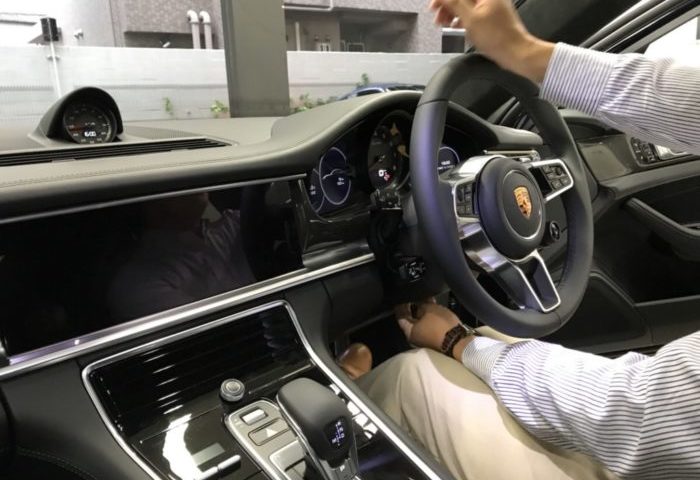

Do You Need to Break In a New Porsche?
In a recent article, a reader asked, “Do you break in your car? Opinions seem to differ, so it would be helpful to hear what your husband thinks.” My husband mentioned that our drive to the WEC race last weekend was partly intended as a break-in drive. Since I didn’t know much about the subject myself, I asked him to explain his approach.
My Husband’s Take on Breaking In a New Car
My husband says,
“Some people break in their cars, and others don’t. I’m in the break-it-in camp. But rather than driving gently to avoid putting any load on the engine, as people often recommend, I think it’s better to let the engine rev to a reasonable level so everything can bed in properly.”
His reason for letting the engine rev is that “dealer demonstrators often have engines that rev freely.”
Demonstrator cars arrive at dealerships in near-new condition. Customers then get behind the wheel, press the accelerator, and rev the engine during test drives. That doesn’t mean the cars end up in poor condition; in fact, they often run smoothly and feel great.
That’s something I’ve noticed after test-driving cars at all sorts of dealerships, both in Japan and overseas. So rather than being overly cautious, he thinks it’s fine to let the engine rev to a reasonable level during break-in.
That said, don’t overdo it. Try to keep the engine between 2,000 and 4,000 rpm as much as possible.
With that in mind, my husband has three key tips for breaking in a new car.
Three Tips for Breaking In Your Porsche
1. Avoid short trips and drive longer distances where possible
Driving mostly around town after delivery—accelerating, revving the engine, stopping at traffic lights, then accelerating and revving again—puts stress on the engine. Instead, maintain a steady rpm and cover a longer distance.
2. Let the engine rev to a reasonable level
Let the engine rev, but don’t put it under too much strain. In practical terms, use the 2,000–4,000 rpm range frequently.
3. Change the oil after the first 1,000 km
Dealers may recommend an oil change at the end of the break-in period. For a Porsche, the suggested point is “after 3,000 km.” The owner’s manual also says so.
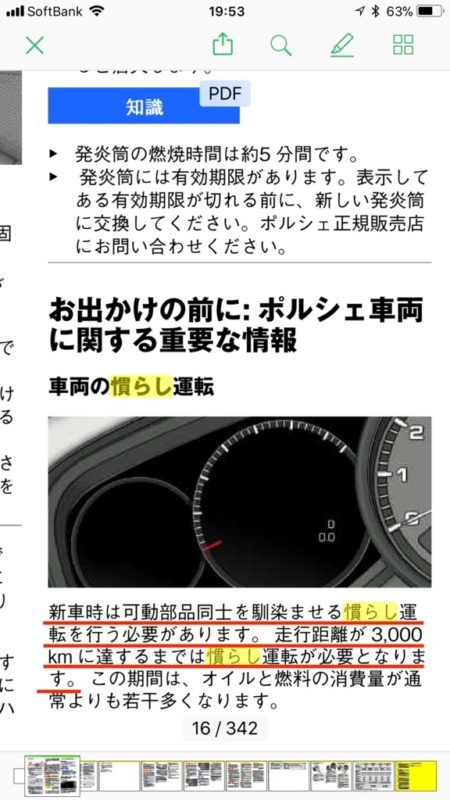
My husband, however, says:
“The dealership where I bought my car told me to ‘change the oil after 1,000 km,’ and I agree with that advice. During break-in, metal parts such as the gears and pistons rub together, producing tiny metal particles that you can’t see. Those particles mix with the oil and collect in the oil filter, leaving the oil full of debris.
So instead of driving 3,000 km on that oil, I’d rather drive the first 1,000 km with the engine revving to a reasonable level, let everything bed in sooner and flush out the metal particles, then change the oil so fewer particles remain in it afterward.”
That’s his reasoning.
A Few More Break-In Notes
Our round trip from home to Fuji for the WEC race covered around 1,100 km. In the mountains, the Panamera Turbo would ideally be driven in second or third gear, but we made a point of staying in third or fourth gear throughout. We also avoided driving in fifth or sixth.
That’s why using the paddle shifters is a good idea during break-in. Fuel economy will suffer, of course, but we prioritized the break-in process this time. We also left the Sport Response button unused, even though it comes with the optional Sport Chrono Package.
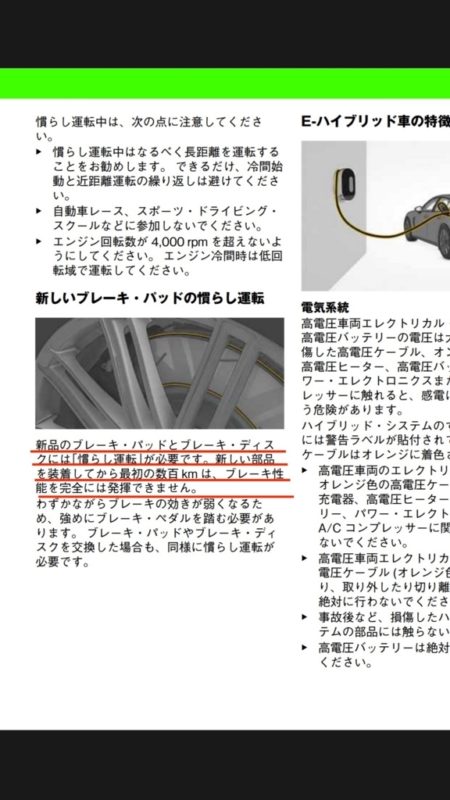
The brakes also need to be broken in. Porsche’s official owner’s manual says so as well.
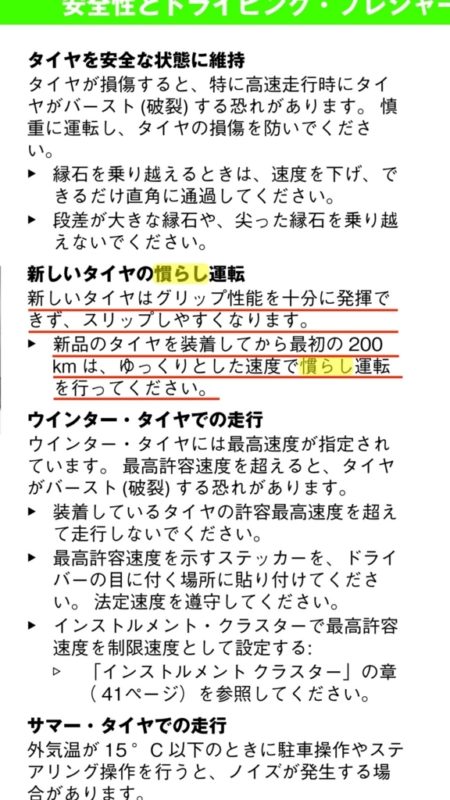
New tires need a break-in, too. New tires are coated with a thin layer, which generally takes around 200 km of driving to wear off. Until then, they may not grip as well. Porsche’s official owner’s manual has this to say:
There’s No One Right Way to Break In a Car
That’s my husband’s take, but there’s no single “right” way to break in a car. Different approaches reflect different opinions. Toyota and Honda, for example, say that new cars don’t need a break-in period, so recommendations vary by manufacturer, too. In the end, the best approach may be to try it for yourself and trust what you learn from the experience.
There’s always more to learn about cars.
このブログが気に入ったらフォローしてね!
Comment ( 0 )
Trackbacks are closed.
No comments yet.