

A Look at the State of the World’s Motor Shows—and the Future of the Auto Industry
公開日:2018.07.07
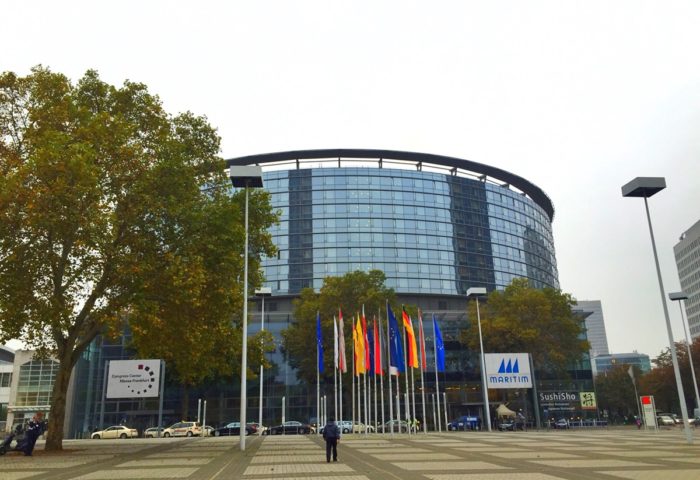

The Frankfurt Motor Show
For a while now, I’ve had this vague little daydream: What if someone said, “We’ll cover your airfare and hotel—would you go to the Frankfurt Motor Show and write about it on your blog?”
I have no idea who might make that offer—or whether anyone would hire an amateur for a job like that. So, yes, it’s pure fantasy. Still, if I’m going to keep writing a blog like this, it would be lovely to become the kind of writer who might one day get asked.
But what exactly is the Frankfurt Motor Show? (You don’t know?!)
My impression was pretty vague: It’s where automakers from around the world unveil new models, in a huge, brightly lit exhibition hall. So I decided to find out more.
What Is a Motor Show?
In Japan, we tend to say “motor show,” while overseas the term “auto show” is more common. The two mean essentially the same thing. So what is a motor show, exactly?
Automobiles and related products are displayed at exhibition centers and similar venues. Since these events attract extensive coverage in newspapers, magazines, and on television, as well as large crowds, they are often used to unveil new models and concept cars.
*Source: Wikipedia, “Motor Show”
The Tokyo Motor Show, Frankfurt Motor Show, and North American International Auto Show were once considered the world’s three major auto shows, held in Japan, Germany, and the United States—the world’s three largest car-producing nations. Today, with the Geneva International Motor Show and Paris Motor Show added to the list, they’re often referred to as the world’s five major auto shows.
After the Tokyo Motor Show, scaled-down versions are also held in Nagoya, Sendai, Osaka, Fukuoka, and Sapporo. I once went to the Osaka show. Compared with the Tokyo Motor Show I’d seen on the news, it was much smaller than I’d expected, and I remember feeling a little disappointed.
Why Do Automakers Exhibit at Motor Shows?
So, what’s the point of exhibiting at a motor show?
Because they can expect large crowds, motor shows are not only an opportunity for automakers to unveil new models; they’re also meant to be enjoyable for visitors, whether or not they’re already interested in cars. Simply displaying production cars would soon get boring, so shows often feature design studies and futuristic experimental vehicles that may never go on sale. Their role as an event that sparks visitors’ curiosity is also important. Ultimately, they aim to advance the automobile and encourage its wider adoption.
*Source: Wikipedia, “Motor Show”
That makes sense. A motor show is more than just a place to launch new cars—it’s also an event, almost a celebration.
The Tokyo Motor Show in Practice
So just how big is the Tokyo Motor Show? I looked into the 2017 event. It ran for 10 days, from October 28 to November 5, and drew 771,200 visitors. That sounds like a huge turnout, but attendance had actually declined for the second show in a row.
One major reason for the drop seems to be that American, Italian, and British automakers weren’t exhibiting. In 2017, that included GM, Ford Motor Company, Alfa Romeo, Fiat, Abarth, Jaguar, Land Rover, and MINI.
The automakers exhibiting in 2017 included:
[Japanese automakers]
Daihatsu, Lexus, Honda, Mazda, Mitsubishi, Nissan, Subaru, Suzuki, and Toyota.
[International automakers]
Alpina, Audi, BMW, Citroën, DS, Mercedes-Benz, Mercedes-AMG, Peugeot, Porsche, smart, smart BRABUS, Renault, Volkswagen, and Volvo.
I think a big part of the appeal is seeing cars from all over the world gathered in one place, so the absence of American, Italian, and British brands must have been a real loss. The Tokyo Motor Show is held every other year, so there wasn’t one scheduled for this year.
| → Next page: Even the Frankfurt Motor Show is losing its shine—and automakers are increasingly turning to esports. |
このブログが気に入ったらフォローしてね!
Comment ( 0 )
Trackbacks are closed.
No comments yet.