

Panamera vs. Panamera Sport Turismo: 4 Key Differences and Our Verdict — Test Drive Comparison, Part 2
公開日:2018.07.26
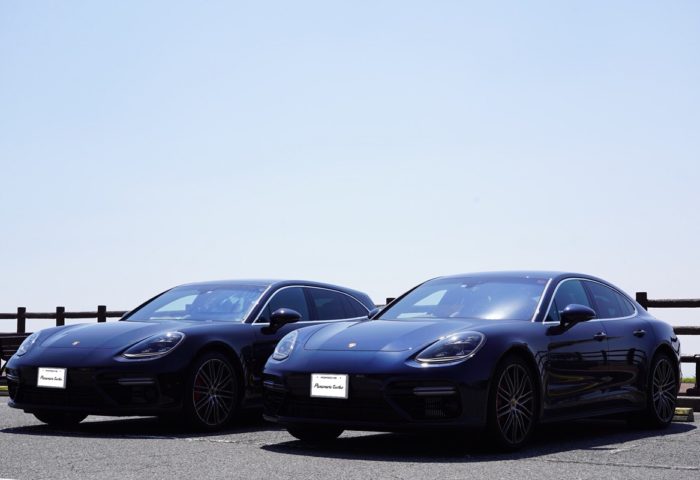

③ Engine Sound With and Without the Sport Exhaust
A lot of people wonder whether the Sport Exhaust is worth adding. My husband’s take was clear: “The sound is completely different in both tone and volume. I’d absolutely get it.” Here’s how the cars with and without the Sport Exhaust (standard exhaust) compare across three situations.
1) Starting the Engine
The standard exhaust and the Sport Exhaust with the system switched off sound almost identical when starting the engine. Both wake up with the kind of assertive bark you’d expect from a Porsche. There may be a subtle difference in tone, but it’s hard to describe—and easy to miss.
2) Sound While Driving
With the Sport Exhaust switched on, the car takes on a deep, rumbling V8 note, and you can clearly hear the exhaust pops as the PDK shifts gears. Without it, the standard exhaust gives you a hint of the V8 at higher revs, but there’s much less of that V8 character at low revs. To our ears, the Sport Exhaust sounds about 1.3 to 1.5 times louder than the standard exhaust.
3) Sound in Sport and Sport Plus Modes
On a car equipped with the Sport Exhaust, the change in sound is easy to hear when you switch to Sport or Sport Plus. With the standard exhaust, though, the difference is barely noticeable—even in Sport or Sport Plus.
So, to sum up:
One major advantage of the Sport Exhaust is that it makes the selected driving mode unmistakable to the driver. That said, even the standard exhaust is quite loud compared with an ordinary sedan. If you don’t want a louder exhaust or aren’t a fan of the V8’s rhythmic rumble, the standard exhaust should be more than enough.
④ Rear-Axle Steering
On the difference between having rear-axle steering and not having it, my husband said:
Around town, I couldn’t tell the difference except when making a U-turn. I didn’t notice anything during slow turns at intersections, overtaking, or passing other cars.
That sounds right. I don’t even make U-turns around town, so I hardly ever notice a difference in everyday driving. (If I can’t make a U-turn, I tend to panic, so I avoid roads where I might need to make one.) What about on the highway?
I covered about 80 km, concentrating as hard as I could on spotting differences in lane changes and high-speed stability, but I couldn’t feel any difference. Maybe it would show up on a racetrack or with more aggressive driving, but I couldn’t tell on the highway during normal lane changes or fast corners. The Panamera has such a capable chassis to begin with that the difference is probably even harder to notice.
So, while rear-axle steering made no noticeable difference around town or on the highway, the contrast became clear on the tight, winding roads we often drive in the Panamera, such as the Royu Driveway.
In the standard chassis setting, the difference isn’t that obvious, but it becomes clear in Sport and Sport Plus. You don’t feel much difference in how the front end turns in, but the rear follows noticeably differently. With rear-axle steering, the rear seems to swing around through the corner and follow the front without a pause. Without it, the rear feels like it follows just a fraction later.
He said the difference also shows up in body roll. The tighter the corner, the less body roll he felt with rear-axle steering—and he believes there really is less. He also found that the car feels smaller and more nimble on mountain roads with rear-axle steering.
Of course, these are subjective impressions. If we use the Panamera without rear-axle steering in the standard chassis setting as our baseline of 1, here’s how my husband would rate the cars on tight, winding mountain roads. (For brevity, the table uses “RS” for rear-axle steering.)
| No RS | With RS | |
| Normal | 1 | 1.1 |
| Sport | 1.1 | 1.3 |
| Sport Plus | 1.2 | 1.5 |
Driving a Panamera with rear-axle steering in Sport Plus mode, my husband was once again amazed that a car over five meters long and weighing two tonnes could feel so agile. His overall take was:
If you’re mainly using the Panamera as a comfortable sedan for family or passengers, or don’t plan to push it on winding roads, I don’t think rear-axle steering is necessary. But if you want to enjoy winding roads in your Panamera, or make U-turns and parking in tight spaces easier, it’s an option worth having.
I agree. It’s incredibly easy to park, and without rear-axle steering, I’m not sure I’d have the confidence to park a Panamera myself (laughs).
Our Test-Drive Comparison Verdict
So, what was my husband’s overall verdict on the Panamera vs. Panamera Sport Turismo?
We’ve gone into the differences in quite a bit of detail, but please take this as a comparison between these two particular cars. As with any Porsche, ride and handling can vary slightly with tire pressure and differences between individual cars. Even so, it was clear that the Panamera and Sport Turismo have subtly different tuning and driving characters.
Both the Panamera and Panamera Sport Turismo have the firm, sporty suspension you’d expect from a sports car. They share the unmistakable Porsche driving character, exceptionally high-speed stability, and cornering ability that defies their size. So whether you buy a Panamera or a Sport Turismo, you can count on world-class performance and the unmistakable appeal of a Porsche.
More important than the differences between the two is what you expect from the Panamera itself. Compared with a Mercedes-Benz S-Class or an AMG S 63, the Panamera is built with a very different purpose in mind. If you buy one expecting an ultra-luxury sedan costing more than ¥25 million, you may find that it doesn’t quite match your expectations.
If you’re buying a Panamera Turbo, you should think of it as “a 911 Turbo or GT3 transformed into a four- or five-seat car, with a substantial boost in luxury.” With that mindset, it should live up to your expectations. As long as you’re looking for the right things, I don’t think you’ll regret buying a Panamera.
That was his conclusion. Wow… after hearing all that, my own test-drive comparison from the other day suddenly felt pretty superficial (-_-). (But it seems a shame to delete it…) So, before you decide between buying a Panamera and a Panamera Sport Turismo, it’s important to start by asking:
“What do I want from a luxury sedan?”
That seems to be the key to choosing a Panamera you won’t regret.
このブログが気に入ったらフォローしてね!
Comment ( 0 )
Trackbacks are closed.
No comments yet.